
Do hip flexor stretches help anterior pelvic tilt? What the studies actually show
16 November 2026 · 8 min read · Tom Brecker, BSc Sports Science · Not a doctor or physical therapist
Educational information, not medical advice. If you have hip, groin or back pain, a hip replacement, or any warning sign below, please get it checked before stretching. This article mentions my own book.
Every evening for about two years, I knelt on a folded towel and stretched the front of my hips. Thirty seconds a side, sometimes longer. I did it because every article, every trainer and every video about anterior pelvic tilt said the same thing: your hip flexors are tight, they pull your pelvis forward, stretch them and the tilt goes away.
My hips felt looser afterwards. That part was real.
And then I would stand up, catch my reflection sideways in the hallway mirror, and see exactly the same lower back arch and the same lower belly pushed forward.
If that sounds familiar, you are not doing the stretch wrong. When researchers actually measured hip flexors and pelvic tilt in the same people, they found something that most posture content leaves out. It explains why the stretch feels good and the mirror does not change, and it changes what is worth spending your evenings on.
I am a sports scientist (BSc), not a doctor, and I have lived with anterior pelvic tilt for more than a decade. Here is what the studies show.
Check this first
Call 911 (or your local emergency number) or go to the emergency room right away if:
- You cannot stand or put weight on your leg after a fall or injury, or your leg suddenly looks shorter or turned in or out, including after a pop or sudden pain in a replaced hip
- Hip, groin or back pain comes with numbness around your genitals or inner thighs, or new trouble controlling your bladder or bowels
- Sudden shortness of breath or chest pain, or sudden weakness or numbness in one or both legs
- Sudden, severe pain in your belly, back or groin, especially with fainting or sweating, or a painful groin bulge that is hard, will not push back in, or comes with nausea or vomiting
See a doctor promptly, and do not start a stretching routine first, if you have:
- Hip or groin pain with fever or chills, severe pain with any movement of the hip, or a replaced hip that becomes newly painful, warm or red or has drainage from the scar (get care the same day)
- One calf or thigh that is swollen, warm and painful, especially after surgery, a long trip or time in bed (get care the same day)
- Groin pain that makes you limp, or that you feel when you bear weight or turn your leg
- Hip or groin pain after a fall, even a minor one and even if you can walk, if you have osteoporosis or low bone density (get checked the same day), or new groin pain without a fall if you have osteoporosis
- Pain that wakes you at night or does not ease with rest
- A history of cancer, long-term steroid use, or weight loss you cannot explain
- A hip replacement or other hip surgery (ask your surgeon which stretches and positions are safe for you)
- Pain, numbness or tingling that spreads down a leg
- Pain that keeps getting worse, or has not improved after 4 to 6 weeks
Most stiffness at the front of the hips is harmless. These signs are less common, but they need a professional to look at them before you work on posture. If you are not sure whether something is urgent, call your doctor's office or a nurse line.
Why everyone tells you to stretch your hip flexors
The theory is simple and sounds anatomical. Your hip flexors run from your lower spine and pelvis to the top of your thigh. If they are short, the story goes, they pull the front of your pelvis down when you stand up, your lower back arches, and your belly tips forward. Long hours of sitting keep the hips bent, so the muscles adapt to being short. Stretch them, and the pelvis returns to level.
It is a tidy story. The trouble is that when you test each step of it, most of the steps turn out to be weaker than they sound.
What researchers found when they measured both
In adults in their 50s, hip flexor length explained little. A Mayo Clinic research team measured 90 adults without back pain. The men averaged about 55 years old and the women about 59, which makes this one of the more relevant studies for readers here. They measured pelvic tilt, the lower-back curve, hip flexor length, abdominal length and activity level. Hip flexor length was linked to the lower-back curve only in men, only together with the other factors, and that combination explained only a minority of the differences between people. In women, it did not come up as a predictor. The authors themselves questioned the habit of prescribing hip flexor stretches to change standing posture (Youdas et al., 1996).
In adults with back pain, no link at all. The same team repeated the measurements in 60 adults with chronic low back pain, average age about 55. Hip flexor length was not linked to pelvic tilt or to the lower-back curve. In the women, tilt was associated with age, body mass index and disability score instead (Youdas et al., 2000).
The "tight hip flexor" test is less reliable than it looks. The usual test is the Thomas test: you lie on the edge of a table, hug one knee and see whether the other thigh lifts. In one study, a weak and not statistically clear relationship showed up between the test result and pelvic tilt (Preece et al., 2021). Another, in 29 young adults, found that unless the position of the pelvis is carefully controlled, the test result can differ from the true hip angle by up to about 20 degrees in either direction (Vigotsky et al., 2016). So a trainer telling you that your hip flexors are tight may not be measuring what they think.
There is also the problem of the bones themselves. Pelvic bones vary enough in shape that the same posture can look tilted in one person and level in another when tilt is judged from the bony landmarks on the outside (Preece et al., 2008). If you want to check your own posture anyway, the anterior pelvic tilt test guide walks through four home checks and how often they are misread.
What happened when people actually stretched
This is the part I wish I had known two years earlier.
One session: about 1 degree. Researchers measured 23 healthy men aged 23 to 50 before and after a session of 12 passive hip flexor stretches. Hip extension improved by about 2.6 degrees and pelvic tilt dropped by about 1.2 degrees, from 7.9 to 6.7 degrees. The lower-back curve did not change at all. People whose hip extension improved the most did not show the biggest change in tilt, and the authors noted that a change of this size is unlikely to be clinically meaningful, although they suggested longer programs might produce larger changes. There was no comparison group, and the study did not test whether the change lasted (Preece et al., 2021).
Eight weeks: no clear change. In a controlled trial in 40 young adults with weak abdominal muscles, eight weeks of abdominal strengthening combined with hip and lower-back stretching made the participants stronger, but pelvic tilt changed by only half a degree, which was not statistically significant (Levine et al., 1997). In a later study, 42 patients aged 18 to 40 with hip pain and a hip socket shape called acetabular retroversion, almost all of them women, did an eight-week home program of core stability, strengthening and stretching. Their tilt dropped by about 1.6 degrees on average, which was not statistically clear, and the researchers judged that it was not clinically relevant (Brekke et al., 2022).
The overall picture. A systematic review that searched for any non-surgical treatment for excessive anterior pelvic tilt found only four studies that qualified. Its conclusion: no overall evidence for an effect, with very low certainty in the evidence (Brekke et al., 2020). Stretching a different muscle shows the same pattern. In a randomized trial of people with tight hamstrings, stretching improved how far they could lift their leg, but their standing posture did not change (Li et al., 1996).
Stretching changed how far the hip could move. It barely changed where the pelvis sat when people stood still.
One honest caveat: none of these studies tested a long, daily stretching program in women over 45 and measured standing pelvic tilt as the result. (The 10-week trial in older adults described below tracked pelvic tilt during walking, but its summary does not report a change in it.) So "it does not work" would be overstating it. The fair summary is that nobody has shown it works for posture, and the studies that came closest found very small changes.
So why does stretching feel like it is working?
Because it changes something real, just not the thing you were hoping for.
When you stretch regularly, you can move further into the stretch. Most of that gain over a few weeks seems to come from your nervous system tolerating the stretch better, rather than from the muscle becoming physically longer (Weppler and Magnusson, 2010). A review of 26 studies of stretching programs lasting three to eight weeks found that the effects on the stiffness and structure of the muscle and tendon were trivial (Freitas et al., 2018).
That is not a reason to dismiss stretching. Feeling less stiff is worth something, and the range you gain is usable range. It also explains why the effect fades. In a review of stretching studies, people who stopped stretching kept some of their gain after two to six weeks but lost part of it, and the loss was mostly seen in people who were otherwise inactive (Konrad et al., 2025).
Where hip flexor stretching does make sense, especially after 45
Here is the reason I still stretch the front of my hips, just for a different goal.
As we get older, we tend to extend the hip less when we walk, meaning the back leg trails behind us less. In one study, peak hip extension while walking averaged about 20 degrees in young adults, 14 degrees in healthy older adults and 11 degrees in older adults who had fallen (Kerrigan et al., 2001). That study shows an association; it does not show that reduced hip extension causes falls.
The same research group then tested a 10-week home program in 96 healthy older adults: hip flexor stretches twice a day, compared with a group doing shoulder stretches. The hip flexor group gained a small amount of hip extension at rest, from about 6 to 8 degrees. During walking, the improvement was about 2 degrees, but it was not statistically clear (Kerrigan et al., 2003).
So the realistic case for hip flexor stretching is this: it may help you keep the ability to open the front of your hip, which you use with every walking step. That is a perfectly good reason to do it. Changing your posture in the mirror is not something the studies have shown.
If you stretch your hip flexors, do it like this
Skip this section if any warning sign above applies. If you have had a hip replacement, ask your surgeon first, because each surgical approach comes with its own limits, for example on how far you bend your hip, take it backward, or turn your leg in or out. If you have had a knee replacement, if kneeling hurts your knees, or if getting down to the floor and back up is hard or unsteady for you, use the standing version instead: stand holding a counter, step one foot back, tuck your tailbone and bend the front knee slightly. If you have osteoporosis, have balance problems or are pregnant, set up next to a sturdy chair or counter and check with your doctor or physical therapist first.
- Set up. Kneel on one knee with the other foot in front, like a half proposal. Hold a chair or wall for balance if you need to.
- Tuck first, then move. Before you lean forward, gently tuck your tailbone under, as if you were flattening your lower back a little. Many people skip this, lean forward with an arched lower back, and feel the stretch mostly in their back rather than the front of the hip.
- Shift forward a little. Keep your chest upright, your front knee roughly over your ankle, and gently squeeze the buttock of the kneeling leg. Move your hips forward only until you feel a mild stretch at the front of the kneeling hip. It should never be sharp or painful. Ease off if you feel a pinch in the front of the hip or groin, and stop if the pinch stays, or if you feel numbness, tingling, dizziness or pain that lasts after you stop.
- Hold and breathe. The American College of Sports Medicine suggests holding a stretch for 10 to 30 seconds for most adults and 30 to 60 seconds for older adults, for about 60 seconds in total per side, on at least 2 to 3 days a week (Garber et al., 2011). Starting with shorter holds is fine.
You can follow along with the guided hip flexor stretch on this site.
What to pair it with
If stretching alone did not change much for you, that is what the research would predict. People who work on anterior pelvic tilt usually combine a few things. The evidence that any of these change the angle of your pelvis is limited too, so the more realistic goal is feeling less stuck in one position:
- Control in both directions. Lying on your back, practice slowly flattening and gently arching your lower back. The guided pelvic tilt reset shows how. Many people with a forward tilt find the flattening direction the harder one.
- Glute and trunk endurance. A slow glute bridge, built up gradually. If you mostly feel it in your lower back or hamstrings, read why APT exercises sometimes do not seem to work.
- Breaking up long sitting. What you do across the whole day probably matters more than ten minutes in the evening. More on that in anterior pelvic tilt from sitting.
- Realistic expectations. Changes tend to show up in how you move and feel before anything shows up in the mirror, if it does at all. Read the honest timeline for anterior pelvic tilt.
If your lower back also aches, what the research says about anterior pelvic tilt and back pain may be the more useful read. And if you would like the basic moves on one printable page, my free APT exercise poster has them.
If you want a structured plan instead of one stretch
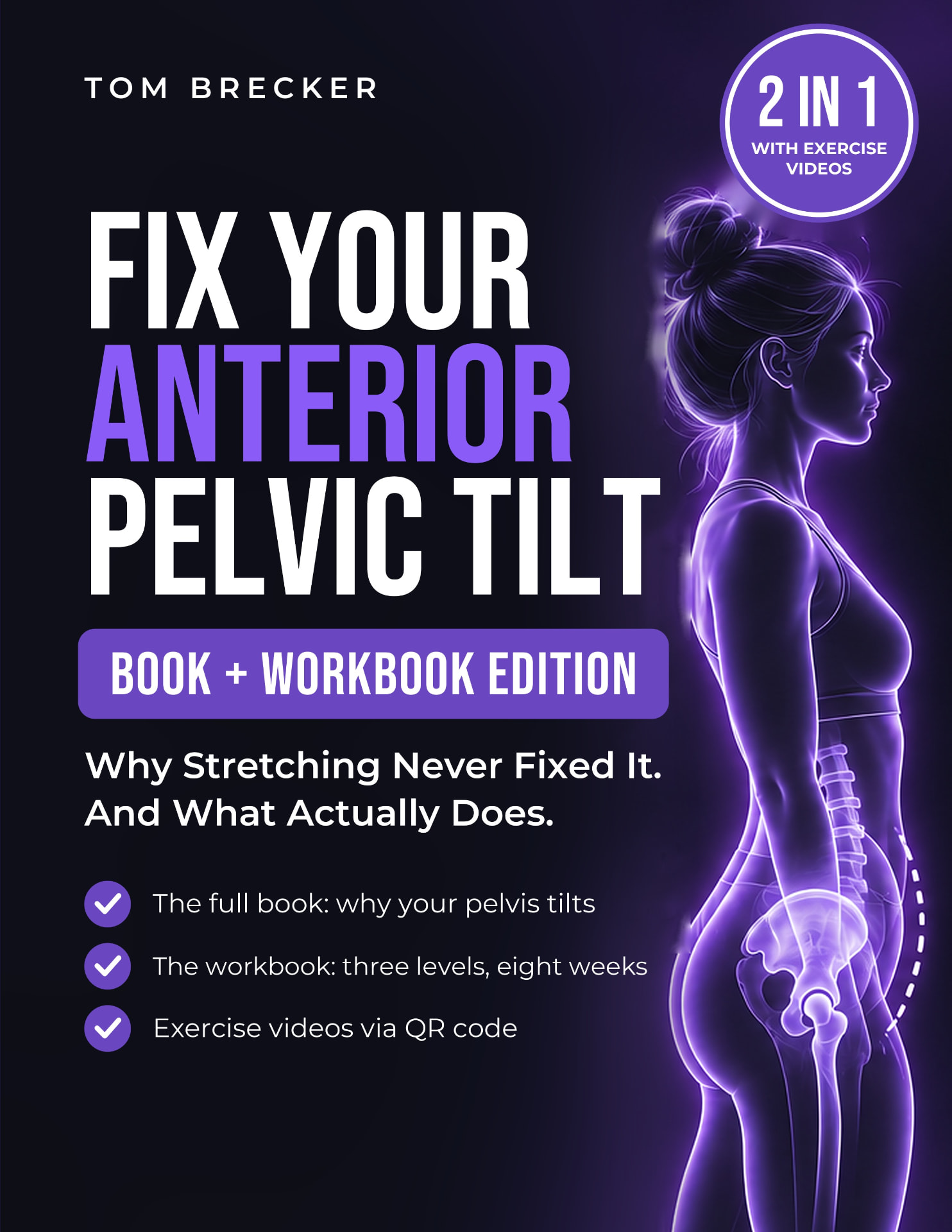
Fix Your Anterior Pelvic Tilt is my own book and workbook (I wrote it and earn money when you buy it) on posture and movement for people who sit a lot. Stretching is one part of it, alongside moving the pelvis with control, building glute and trunk endurance, and small habits for the hours outside your workout. It includes the Wall Gap Test as a simple self-check you can repeat (home posture checks are easy to misread), an 8-week plan with three levels per exercise (Beginner, Brecker-Standard, Pro), illustrations and video demos. The studies cited above were not done on this book.
It is an exercise and education program. It does not diagnose or treat any medical condition, and no program can promise a change in your posture. If you have pain or a hip replacement, ask your doctor or physical therapist whether the exercises suit you. Results vary.
Instant PDF download.
Frequently asked questions
Do tight hip flexors cause anterior pelvic tilt?
The link is much weaker than most posture content suggests. In a study of 90 adults without back pain, average age in the mid-to-late 50s, hip flexor length was linked to the lower-back curve only in men, only in combination with other factors, and the models explained a small part of the differences between people. A later study in adults with chronic back pain found no link between hip flexor length and pelvic tilt at all.
Can stretching my hip flexors change my pelvic tilt?
The evidence is thin. In the one study that measured pelvic tilt right after a hip flexor stretching session, tilt dropped by about 1 degree on average, which the researchers said may not be meaningful, and the lower-back curve did not change. A systematic review of non-surgical approaches for excessive anterior pelvic tilt found no overall evidence that any of them change it, with very low certainty in the evidence.
Why do my hips feel looser after stretching if nothing changes?
Because something does change: how much stretch your body is willing to tolerate. Reviews of stretching research suggest that most gains in range of motion over a few weeks come from changes in sensation rather than from muscles getting physically longer. That is a real and useful effect. It just is not the same as your pelvis sitting in a different position when you stand.
Is hip flexor stretching still worth doing after 45?
It can be, for a different reason than posture. Older adults tend to extend their hips less when they walk than younger adults do. In a 10-week trial in healthy older adults, a daily home hip flexor stretching routine produced a small gain in hip extension measured at rest, and a small, not statistically clear trend while walking. If the front of your hips feels stiff, keeping that range is a reasonable goal.
How long should I hold a hip flexor stretch?
The American College of Sports Medicine suggests holding stretches for 10 to 30 seconds for most adults and 30 to 60 seconds for older adults, adding up to about 60 seconds per muscle group, on at least 2 to 3 days a week. Daily stretching gives a bit more. Gains in range of motion fade over the following weeks if you stop, especially if you are not otherwise active.
What should I do instead of only stretching?
Stretching can be one piece. People who work on anterior pelvic tilt often also practice moving the pelvis in both directions with control, build glute and trunk endurance gradually, and break up long stretches of sitting and standing. The evidence that any of this changes the angle of the pelvis is limited too, so the more realistic goals are moving more freely and feeling less stuck.
When should I see a doctor about hip or groin pain?
Call 911 or go to the emergency room if you cannot put weight on your leg after a fall, your leg suddenly looks shorter or turned in or out, you have numbness around your genitals or new trouble controlling your bladder or bowels, you have sudden shortness of breath or chest pain, or you have sudden severe pain in your belly, back or groin or a painful groin bulge that will not go back in. Get care the same day for hip or groin pain with fever or chills, a swollen, warm and painful calf or thigh, a replaced hip that becomes newly painful, warm or red, or any hip or groin pain after a fall if you have osteoporosis, even if you can walk. See a doctor soon for groin pain that makes you limp, pain that wakes you at night, pain that spreads down a leg, pain that has not improved after 4 to 6 weeks, or hip pain with a history of cancer or long-term steroid use. If you have had a hip replacement, ask your surgeon before doing hip flexor stretches.
Related reading
- Anterior pelvic tilt: the complete guide
- Anterior pelvic tilt from sitting
- Why APT exercises sometimes do not seem to work
- Does anterior pelvic tilt cause lower back pain?
Sources
- Youdas JW, Garrett TR, Harmsen S, Suman VJ, Carey JR. Lumbar lordosis and pelvic inclination of asymptomatic adults. Physical Therapy. 1996;76(10):1066-1081. doi:10.1093/ptj/76.10.1066
- Youdas JW, Garrett TR, Egan KS, Therneau TM. Lumbar lordosis and pelvic inclination in adults with chronic low back pain. Physical Therapy. 2000;80(3):261-275. doi:10.1093/ptj/80.3.261
- Preece S, Tan Y, Alghamdi T, Arnall F. Comparison of pelvic tilt before and after hip flexor stretching in healthy adults. Journal of Manipulative and Physiological Therapeutics. 2021;44(4):289-294. doi:10.1016/j.jmpt.2020.09.006
- Vigotsky AD, Lehman GJ, Beardsley C, Contreras B, Chung B, Feser EH. The modified Thomas test is not a valid measure of hip extension unless pelvic tilt is controlled. PeerJ. 2016;4:e2325. doi:10.7717/peerj.2325
- Preece SJ, Willan P, Nester CJ, Graham-Smith P, Herrington L, Bowker P. Variation in pelvic morphology may prevent the identification of anterior pelvic tilt. Journal of Manual & Manipulative Therapy. 2008;16(2):113-117. doi:10.1179/106698108790818459
- Levine D, Walker JR, Tillman LJ. The effect of abdominal muscle strengthening on pelvic tilt and lumbar lordosis. Physiotherapy Theory and Practice. 1997;13(3):217-226. doi:10.3109/09593989709036465
- Brekke AF, Overgaard S, Mussmann BR, Poulsen E, Holsgaard-Larsen A. Exercise in patients with acetabular retroversion and excessive anterior pelvic tilt: a feasibility and intervention study. Musculoskeletal Science and Practice. 2022;61:102613. doi:10.1016/j.msksp.2022.102613
- Brekke AF, Overgaard S, Hróbjartsson A, Holsgaard-Larsen A. Non-surgical interventions for excessive anterior pelvic tilt in symptomatic and non-symptomatic adults: a systematic review. EFORT Open Reviews. 2020;5(1):37-45. doi:10.1302/2058-5241.5.190017
- Li Y, McClure PW, Pratt N. The effect of hamstring muscle stretching on standing posture and on lumbar and hip motions during forward bending. Physical Therapy. 1996;76(8):836-845. doi:10.1093/ptj/76.8.836
- Weppler CH, Magnusson SP. Increasing muscle extensibility: a matter of increasing length or modifying sensation? Physical Therapy. 2010;90(3):438-449. doi:10.2522/ptj.20090012
- Freitas SR, Mendes B, Le Sant G, Andrade RJ, Nordez A, Milanovic Z. Can chronic stretching change the muscle-tendon mechanical properties? A review. Scandinavian Journal of Medicine & Science in Sports. 2018;28(3):794-806. doi:10.1111/sms.12957
- Konrad A, Warneke K, Donti O, Panidi I, Gaspari V, Nakamura M, Thomas E, Bogdanis GC. Detraining effects following chronic stretching training on range of motion: a systematic review and meta-analysis. Sports Medicine - Open. 2025;11:141. doi:10.1186/s40798-025-00935-5
- Kerrigan DC, Lee LW, Collins JJ, Riley PO, Lipsitz LA. Reduced hip extension during walking: healthy elderly and fallers versus young adults. Archives of Physical Medicine and Rehabilitation. 2001;82(1):26-30. doi:10.1053/apmr.2001.18584
- Kerrigan DC, Xenopoulos-Oddsson A, Sullivan MJ, Lelas JJ, Riley PO. Effect of a hip flexor-stretching program on gait in the elderly. Archives of Physical Medicine and Rehabilitation. 2003;84(1):1-6. doi:10.1053/apmr.2003.50056
- Garber CE, Blissmer B, Deschenes MR, et al. American College of Sports Medicine position stand: quantity and quality of exercise for developing and maintaining cardiorespiratory, musculoskeletal, and neuromotor fitness in apparently healthy adults. Medicine & Science in Sports & Exercise. 2011;43(7):1334-1359. doi:10.1249/MSS.0b013e318213fefb
Medical disclaimer
This article is for general education only. It is not medical advice and does not replace diagnosis or treatment from a doctor, physical therapist or other qualified professional. Tom Brecker is a pen name; the author holds a BSc in Sports Science and is not a doctor or physical therapist. Reading this article does not create a patient or client relationship.
Talk to your doctor before starting a new exercise program, especially if you have hip, groin or back pain, a hip replacement or other joint surgery, osteoporosis, a heart condition, or are pregnant. Stop any exercise that causes pain, numbness, tingling or dizziness.
Individual results vary. No exercise, book or program can guarantee a result, and nothing on this site is intended to diagnose, treat, cure or prevent any disease.
Disclosure: I wrote the book mentioned here and earn money when you buy it.
Research summaries reflect the sources listed above and are not a complete review of the evidence.
Part of the Anterior Pelvic Tilt guide. Read the complete guide to anterior pelvic tilt