
Anterior pelvic tilt test: 4 ways to check at home (and why most people misread the result)
29 October 2026 · 10 min read · Tom Brecker, BSc Sports Science
Educational information, not medical advice. Home checks are not a diagnosis.
An anterior pelvic tilt test at home can tell you roughly whether your pelvis tips forward when you stand, but no home test can give you an exact angle. That matters, because most people who search "do I have anterior pelvic tilt" end up comparing one number to a stranger on the internet, and that comparison says very little.
Below are four simple home checks for anterior pelvic tilt, what each one can and cannot tell you according to the research, and the one check that matters more than all four.
Short answer: The most common home tests for anterior pelvic tilt are the wall test (the gap behind your lower back), the hip bone check (front hip bones lower than the back ones), the lying-down check (does your lower belly flatten when you lie down) and the hip flexor test (does your thigh lift off the bed). None of them is a diagnosis. Some forward tilt is normal: in one study of 120 healthy young adults, 85 percent of men and 75 percent of women stood in anterior pelvic tilt (Herrington, 2011). Bone shape alone varies by up to 23 degrees between people (Preece et al., 2008), so a single result means less than most videos suggest. Home checks are most useful when you repeat them the same way and compare yourself with yourself over time.
Before you test: what counts as anterior pelvic tilt?
Anterior pelvic tilt means the front of your pelvis tips forward and down while the back rises. The lower back usually arches more, the bottom sits further back and the lower belly is pushed forward.
Here is what most posture content leaves out: a forward-tilted pelvis is the normal standing position for most people. In a study by physiotherapy researcher Lee Herrington at the University of Salford, 85 percent of the men and 75 percent of the women, all healthy and pain free, stood with an anterior pelvic tilt (Herrington, 2011). So the question is not "do I have it?" For most people the answer is yes. The useful questions are how pronounced it is, whether it bothers you, and whether you can move out of it.
Anterior pelvic tilt test 1: the wall test
Stand with your back against a wall, heels about a hand's width away. Let your head, shoulder blades and bottom touch the wall. Slide one flat hand into the space behind your lower back.
What people usually conclude: "My whole hand fits, so I have anterior pelvic tilt."
What the result can tell you: a large gap often goes with a stronger arch in the lower back, which often goes with a forward-tilted pelvis.
What it cannot tell you: the gap also depends on the size of your glutes, the shape of your spine and how you stand that day. I am not aware of any study that has validated the wall test as a measure of pelvic tilt. Treat it as a personal reference point, not a verdict.
How to use it well: same wall, same shoes or barefoot, same time of day, and note roughly how much fits (fingers, flat hand, hand and more). Then repeat it in four weeks. The full wall check is also described in why your lower belly sticks out.
Anterior pelvic tilt test 2: the hip bone check
Stand side-on to a mirror or ask someone to help. Find the bony point at the front of your hip (the ASIS, where a belt often sits) and the small bony point at the back (the PSIS, usually under the dimples above your bottom). Put one finger on each and look at the line between them.
What people usually conclude: "The front is lower than the back, so my pelvis is tilted."
What the research says: this is the classic way therapists estimate pelvic tilt, but bone shape gets in the way. When researchers at the University of Salford measured 30 pelves held in exactly the same position, the angle between these two landmarks still ranged from 0 to 23 degrees, with an average of 13 degrees, and the left and right side of the same pelvis differed by up to 11 degrees (Preece et al., 2008). In other words, part of what you feel with your fingers is your skeleton, and exercise does not change your skeleton.
A review of clinical pelvic tilt measures in the International Journal of Sports Physical Therapy also notes that no studies have directly tested how reliable visual assessment of pelvic tilt is (Suits, 2021). Tools such as a caliper inclinometer used by trained clinicians have better data behind them.
How to use it well: if you use this check, use it to compare yourself before and after, never to compare yourself with someone else.
Anterior pelvic tilt test 3: the lying-down check
Look at your lower belly from the side while standing relaxed. Then lie on your back with your knees bent and look again.
What it can tell you: if the lower belly is clearly flatter lying down and pushes forward when you stand, position is likely part of what you see. If it looks much the same in both positions, body fat or other factors probably play a bigger role.
What it cannot tell you: gravity moves soft tissue in every body, so look for a clear difference, not a small one. Bloating can also change the picture through the day. If your belly gets noticeably bigger by evening, read bloated by evening, or is it your pelvis?, and if you are unsure whether it is fat or position, read skinny fat or anterior pelvic tilt.
Anterior pelvic tilt test 4: the hip flexor test (modified Thomas test)
Skip this test if you have had hip or back surgery, a hip replacement, a recent injury, if you are pregnant, or if it causes pain. Stop immediately if anything hurts.
Sit on the very edge of a sturdy bed or table. Lie back and pull both knees to your chest. Keep one knee held firmly to your chest, which keeps your lower back flat and your pelvis still. Slowly lower the other leg until it hangs over the edge, and let it relax.
What people usually look for: if the back of the relaxed thigh stays lifted above the bed, the hip flexors at the front may be short. If the knee straightens, the thigh muscle at the front may be tight.
What the research says: this test only means something when the pelvis stays still. A study in PeerJ by Vigotsky and colleagues found that when pelvic tilt was not controlled, the modified Thomas test was poor at detecting limited hip extension, with a sensitivity of about 32 percent and a specificity of about 57 percent. When pelvic tilt was taken into account, it worked far better (Vigotsky et al., 2016). That is why holding the other knee firmly to your chest is not optional.
And one more honest point: short hip flexors and anterior pelvic tilt are often mentioned together, but in a study of 90 adults, hip flexor length, abdominal strength and other factors explained only a small part of how far people's pelvises tilted (Youdas et al., 1996). A positive hip flexor test does not prove your tilt comes from your hip flexors.
The 4 anterior pelvic tilt tests at a glance
| Home check | What it can show | Research behind it | Main pitfall |
|---|---|---|---|
| Wall test | How strong your lower back arch is | No validation study known | Glute size and spine shape change the gap |
| Hip bone check | Rough direction of pelvic tilt | Bone shape varies by up to 23 degrees between pelves | Part of the result is skeleton, not posture |
| Lying-down check | Whether position changes how your belly looks | Simple observation, not formally tested | Bloating and soft tissue change the picture |
| Hip flexor test | Whether hip extension may be limited | Valid only when the pelvis is held still | Easy to do with a moving pelvis, which makes it misleading |
The test most people never do: can you move it?
All four checks above ask where your pelvis sits. The more useful question is whether you can move it.
Stand side-on to a mirror, knees soft. Slowly tip your pelvis forward, as if pouring water out of a bowl at the front, then slowly tip it back, tucking your tailbone under. Do it five times, then try to stop in the middle.
Notice three things: Is one direction much harder than the other? Does your lower back or your knees do the moving instead of your pelvis? Can you find the middle, or does your body snap back to the old position?
Why this matters more than an angle: when researchers compared people with and without low back pain, the shape of the lower back when standing differed little between the groups, but people with pain tended to move less and more slowly (Laird et al., 2014). Being stuck in one position seems to matter more than the exact angle. You can also practise this movement lying down with the guided pelvic tilt reset.
What your results mean, and what they do not
If several checks point the same way (a large wall gap, a belly that flattens lying down, a pelvis that is hard to tip back), position is likely a real part of your picture. That is useful to know, because it changes where you start.
If your checks disagree, that is normal. Home tests are rough tools, and bodies are not built from a template.
What no home test tells you is the order to work in. A pronounced arch with weak glute control needs a different starting point than a stiff hip with a lower back that does all the moving. That is also why so many people do the right exercises and see no change: the body often completes them with the wrong muscles, a pattern I call the Evasive Training Pattern. And if you sit for most of the day, read why sitting shows up when you stand.
When to see a professional instead of testing at home
See a doctor or physiotherapist if you have back or hip pain that is severe, getting worse or lasts more than a few weeks, pain that spreads into your leg, numbness, tingling or weakness, pain after a fall or injury, pain at night or with fever or unexplained weight loss, or groin pain when you move your hip. Seek emergency care immediately for numbness around your genitals or bottom, new problems controlling your bladder or bowel, or sudden weakness in your legs.
Turn your result into a plan
A home check gives you a starting point. What changes things is a baseline you measure the same way every time, a training order that matches your result, and a way to see progress before the mirror shows it. Most people skip all three, judge themselves by the mirror after two weeks, and quit. I wrote about that timeline in how long it takes to change anterior pelvic tilt.
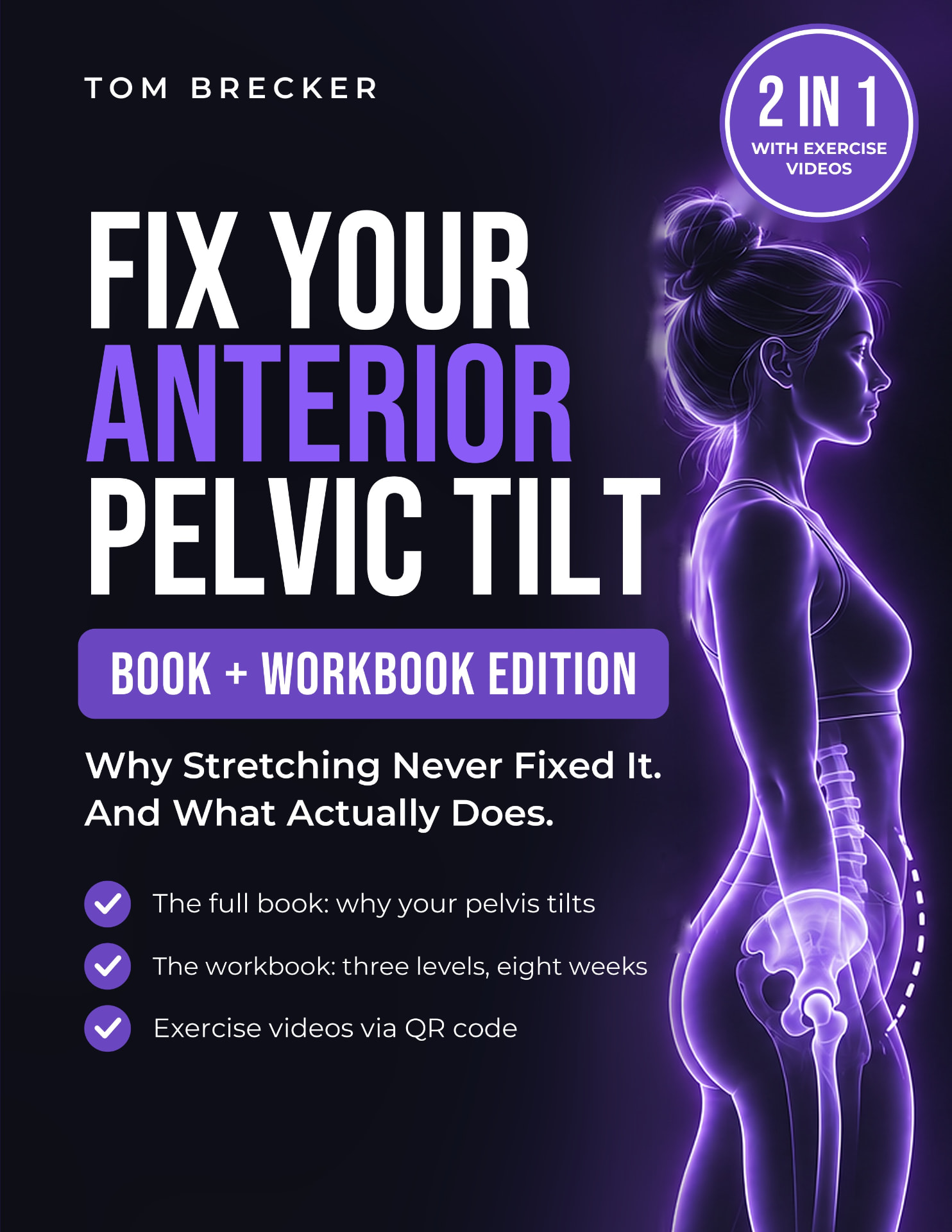
Fix Your Anterior Pelvic Tilt: Book + Workbook Edition
- The book: what your wall gap really tells you and the mistake most people make when reading it, why your pelvis tilts, the Evasive Training Pattern, and the daily micro habits for the hours outside your workout
- The workbook: baseline tests so you can measure where you start, three training tracks (Beginner, Standard, Advanced), illustrated exercises, video demos via one tap or QR code, and an 8-week tracker
- A separate printable tracker in US Letter and A4
Get the Book + Workbook ($19.99)Prefer the paperback? Get it on Amazon
Educational self-help, not medical treatment. Results vary from person to person.
Frequently asked questions
How do I test for anterior pelvic tilt at home?
Common home checks are the wall test (the gap behind your lower back), the hip bone check (comparing the front and back hip bones), the lying-down check (whether your lower belly flattens when you lie down) and the modified Thomas test for hip flexor length. None of them is a diagnosis, and they work best when you repeat them the same way and compare yourself over time.
How do I know if I have anterior pelvic tilt?
Signs include a stronger arch in the lower back, a bottom that sits further back and a lower belly that pushes forward when you stand but looks flatter lying down. Some anterior pelvic tilt is normal: in one study of 120 healthy young adults, 85 percent of men and 75 percent of women stood in anterior pelvic tilt.
Is the wall test accurate for anterior pelvic tilt?
Not as an exact measure. The gap behind your lower back also depends on glute size, spine shape and how you stand, and the wall test has not been validated as a measure of pelvic tilt. It is useful as a personal reference point that you repeat the same way over time.
How many degrees of anterior pelvic tilt is normal?
There is no single normal value. Studies of healthy adults show a wide range, and bone shape alone can change the measured angle: in one study of 30 pelves held in the same position, the angle between the front and back hip bones ranged from 0 to 23 degrees. A home measurement is too rough to compare with published numbers.
Can a photo or mirror show anterior pelvic tilt?
A side photo can show your general posture and is useful for comparing yourself over time. However, no studies have directly tested how reliable visual assessment of pelvic tilt is, so a photo should not be used as a diagnosis.
Does a positive Thomas test mean I have anterior pelvic tilt?
No. The Thomas test looks at hip extension and hip flexor length, not pelvic position. It is only meaningful when the pelvis is held still, and research shows that hip flexor length explains only a small part of how far the pelvis tilts.
Should I see a doctor about anterior pelvic tilt?
Anterior pelvic tilt on its own is common and usually not a medical problem. See a doctor or physiotherapist if you have pain that is severe, getting worse, spreads into your leg, or comes with numbness or weakness, and seek emergency care for numbness around the genitals or new bladder or bowel problems.
How long does it take to change anterior pelvic tilt?
It varies a lot. Many people notice better muscle control within a few weeks of consistent practice, while changes in how they stand without thinking about it often take a few months. Research has not established how reliably exercise changes standing pelvic position long term.
Sources
- Herrington L. Assessment of the degree of pelvic tilt within a normal asymptomatic population. Manual Therapy. 2011;16(6):646-648.
- Preece SJ, Willan P, Nester CJ, Graham-Smith P, Herrington L, Bowker P. Variation in pelvic morphology may prevent the identification of anterior pelvic tilt. Journal of Manual and Manipulative Therapy. 2008;16(2):113-117.
- Suits WH. Clinical measures of pelvic tilt in physical therapy. International Journal of Sports Physical Therapy. 2021;16(5):1366-1375.
- Vigotsky AD, Lehman GJ, Beardsley C, Contreras B, Chung B, Feser EH. The modified Thomas test is not a valid measure of hip extension unless pelvic tilt is controlled. PeerJ. 2016;4:e2325.
- Youdas JW, Garrett TR, Harmsen S, Suman VJ, Carey JR. Lumbar lordosis and pelvic inclination of asymptomatic adults. Physical Therapy. 1996;76(10):1066-1081.
- Laird RA, Gilbert J, Kent P, Keating JL. Comparing lumbo-pelvic kinematics in people with and without back pain: a systematic review and meta-analysis. BMC Musculoskeletal Disorders. 2014;15:229.
This article is for educational purposes only and is not medical advice, diagnosis or treatment. Tom Brecker is a sports scientist, not a physician. Home checks cannot replace an examination. If you have pain, numbness, weakness or any of the warning signs above, see a doctor or physiotherapist.
Part of the Anterior Pelvic Tilt guide. Read the complete guide to anterior pelvic tilt