
Bloated by evening? Why your belly looks bigger at 6 p.m. than at 8 a.m. (and why it is often not just gas)
25 October 2026 · 9 min read · Tom Brecker, BSc Sports Science
Educational information, not medical advice. Persistent bloating needs a doctor, see the warning signs below.
You wake up and your belly is flat. You feel almost normal in your jeans. By late afternoon the waistband digs in, your lower belly pushes forward, and by dinner you look a few months pregnant in the mirror.
So you blame the bread. Or the beans. Or the coffee. You cut foods, buy enzymes, try peppermint tea. Some days it helps. Most days, by 6 p.m., the belly is back.
Here is something most bloating advice never mentions: in research on people with visible bloating, the extra belly often was not explained by extra gas. It was explained by how the muscles around the belly reacted to it.
Short answer: A belly that gets bigger through the day can have several causes: gas and food, fluid, constipation, hormones, body fat and posture. Research from a gastroenterology group in Barcelona found that in many people with functional bloating, the visible swelling was not mainly caused by more gas, but by a muscle reflex: the diaphragm pushes down and the front belly wall lets go, so the contents move forward. Posture may add to the picture, because a pelvis that tips forward can make the lower belly sit further forward when you stand. These are different problems and need different approaches, so it helps to find out which one is bigger for you. Bloating on most days for three weeks or more, or bloating with warning signs, needs a doctor first.
Three reasons a belly can look bigger by evening
Most people treat evening bloating as one problem. It is usually a mix of up to three.
| Gas and food | Belly wall reflex | Pelvic position | |
|---|---|---|---|
| What is happening | Gas, food volume, fluid or constipation add volume inside | The diaphragm pushes down and the belly wall relaxes outward when the gut feels full | The pelvis tips forward and pushes the lower belly out when you stand |
| Typical pattern | Tied to certain meals or foods, often with wind or rumbling | Swelling builds fast after meals and is very visible, often more than the amount of food would suggest | Present most of the day when standing, stronger after long sitting or standing |
| Lying down | Changes a little | Often clearly smaller lying down | Often clearly flatter lying down |
| What it feels like | Pressure, gurgling, sometimes pain | Tight, full, "pushed out" | Firm lower belly, arched lower back, tired back at the end of the day |
| Where to start | Food diary, regular meals, a doctor if symptoms persist | Calm breathing and belly wall control, a doctor or gastroenterologist for proper diagnosis | Pelvic awareness, glute and deep core work, daily posture habits |
Many people have more than one column. That is the reason a single fix rarely works.
What the research found: the bloated belly is often a muscle response
For years, the assumption was simple: bloated belly, too much gas. Then a research group at Vall d'Hebron University Hospital in Barcelona started measuring what actually happens inside the abdomen.
In healthy people, the body adapts when the gut fills up. The diaphragm relaxes upward a little and the front belly wall firms up, so the belly gets only slightly bigger (Villoria et al., 2008).
In people with functional bloating, the same gas load produced a different response: the diaphragm contracted and moved down, and the internal oblique muscles of the belly wall relaxed. The result was significantly more visible distension from the same amount of gas (Villoria et al., 2011). The researchers called this pattern abdomino-phrenic dyssynergia.
Using CT scans, the same group later showed that during episodes of visible bloating in these patients, the diaphragm descended and the front belly wall protruded (Barba et al., 2015). Their conclusion was that the distension behaves like a learned muscular response of the trunk wall.
And then the most interesting part: it can be retrained. In a randomized, placebo-controlled trial with 48 patients, a few sessions of muscle biofeedback training, where patients watched their own muscle activity on a screen and learned to control it, improved the sensation of bloating by 56 percent, compared with 13 percent in the placebo group (Barba et al., 2017).
The honest limits
These studies were done in specialist clinics, mostly with women who had diagnosed functional gut disorders, after other causes had been ruled out. The biofeedback used special equipment and trained staff, and no home exercise has been shown to do the same. None of these studies looked at pelvic position. So this research does not prove that your bloating is a muscle reflex, and it does not prove a link to anterior pelvic tilt. It shows something useful, though: how the trunk muscles hold the belly can change how big it looks.
Where posture comes in
The belly sits in a container. The diaphragm is the lid, the belly wall is the front, the pelvic floor is the bottom, and the pelvis is the base everything rests on.
When the pelvis tips forward, as in anterior pelvic tilt, the lower back arches more and the lower belly is pushed forward when you stand. That is position, not volume. If the belly wall is also relaxed and the breath sits high and tight under the ribs, the container changes shape from two sides at once.
That is a working model, not a proven mechanism. But it fits a pattern many people describe: a belly that looks fine lying down, gets bigger through the day, and comes with a tired, arched lower back and a general feeling of holding everything tight.
If that last part sounds familiar, you are not imagining it. Bracing (shoulders up, breath high, jaw set, belly either sucked in or letting go) is a whole-body pattern for many people. It shows up in the neck as tension headaches, in the evening as feeling tired but wired, and at the pelvic floor as the clenched floor most Kegel programs miss.
The 2-minute evening check
You need a tape measure and a floor. This is a home check, not a diagnosis.
- In the morning, before breakfast, measure your waist at the level of your belly button while standing relaxed. Do not suck in. Write it down.
- In the evening, when the belly feels biggest, measure again standing.
- Then lie on your back with your knees bent for two minutes and measure once more.
- Finally, stand with your heels, bottom and shoulder blades against a wall and slide a flat hand into the gap behind your lower back. A large gap often goes with a forward-tilted pelvis. The full wall check is explained here.
How to read it:
- Big difference between morning and evening, and it shrinks clearly when you lie down: the muscle response and position are likely part of your picture.
- Big difference that barely changes lying down, together with wind, pain or changed bowel habits: digestion is likely the bigger factor, and that is a topic for your doctor.
- Small difference all day, but a lower belly that always sits forward when standing and a large wall gap: posture is likely the bigger factor. If you are unsure whether it is fat or position, read skinny fat or anterior pelvic tilt.
See a doctor first, and do not rely on any home check, if you have bloating on most days for three weeks or more, feel full quickly or have lost your appetite, need to pee more often or more urgently, have unexplained weight loss, blood in your stool, a change in bowel habits, ongoing tummy or pelvic pain, vomiting, fever, or bleeding after menopause. Persistent bloating can be a symptom of ovarian cancer and other conditions that need treatment, and the NHS advises women to get it checked. If you could be pregnant, take a test first.
3 things you can try this week
These are low-risk starting points. They are not a treatment for bloating or any digestive condition.
1. A slow walk after your biggest meal
Ten to fifteen minutes of easy walking after a meal is one of the simplest habits there is. In a small study by the same Barcelona group, mild physical activity helped patients with bloating clear intestinal gas and reduced their symptoms (Villoria et al., 2006). It also breaks up long sitting, which matters for the posture side.
2. Breathe low and slow after eating
Sit or stand tall. Breathe in gently through your nose, then breathe out for longer than you breathed in, and at the end of the exhale let your lower belly draw in gently, like zipping up tight jeans. Do not suck in hard or hold your breath. Five slow breaths. This is not the clinical biofeedback from the studies, but it practises the same direction: less pushing down from the top, a little more support at the front. Use the guided breathing reset or The Long Exhale.
3. Find your pelvis
Lie on your back with your knees bent. Slowly flatten your lower back toward the floor, then let it arch a little away. Rock between the two ten times and finish in the middle. Many people find they can barely feel this movement at first. Try the guided pelvic tilt reset.
Here is the catch: these three moves help you notice what is going on. They do not change a pattern your body has practised for years. That takes structure, the right order and time, and it is where most people stop.
What about back pain and feeling tight all over?
A tilted pelvis and back pain are not linked as directly as most posture content claims. Research comparing people with and without low back pain found little difference in the shape of the lower back when standing, but people with pain tended to move less and more slowly (Laird et al., 2014). Being stuck in one position seems to matter more than the exact angle. I go into that in how long it takes to change anterior pelvic tilt.
The same idea applies to bloating and tension: the aim is not to hold your belly in or force your pelvis into a perfect position all day. It is to give your body more options, so it can let go, breathe low and move freely again.
If your back pain is severe, radiates into your legs, comes with numbness or weakness, or started after an injury, see a doctor or physiotherapist.
If your check points to posture
If the lying-down test and the wall check tell you that position is a big part of your belly, the work is less about food and more about how you stand, sit, breathe and train every day. And that is exactly where most exercise routines quietly fail: the body does the exercises with the wrong muscles, a pattern I call the Evasive Training Pattern.
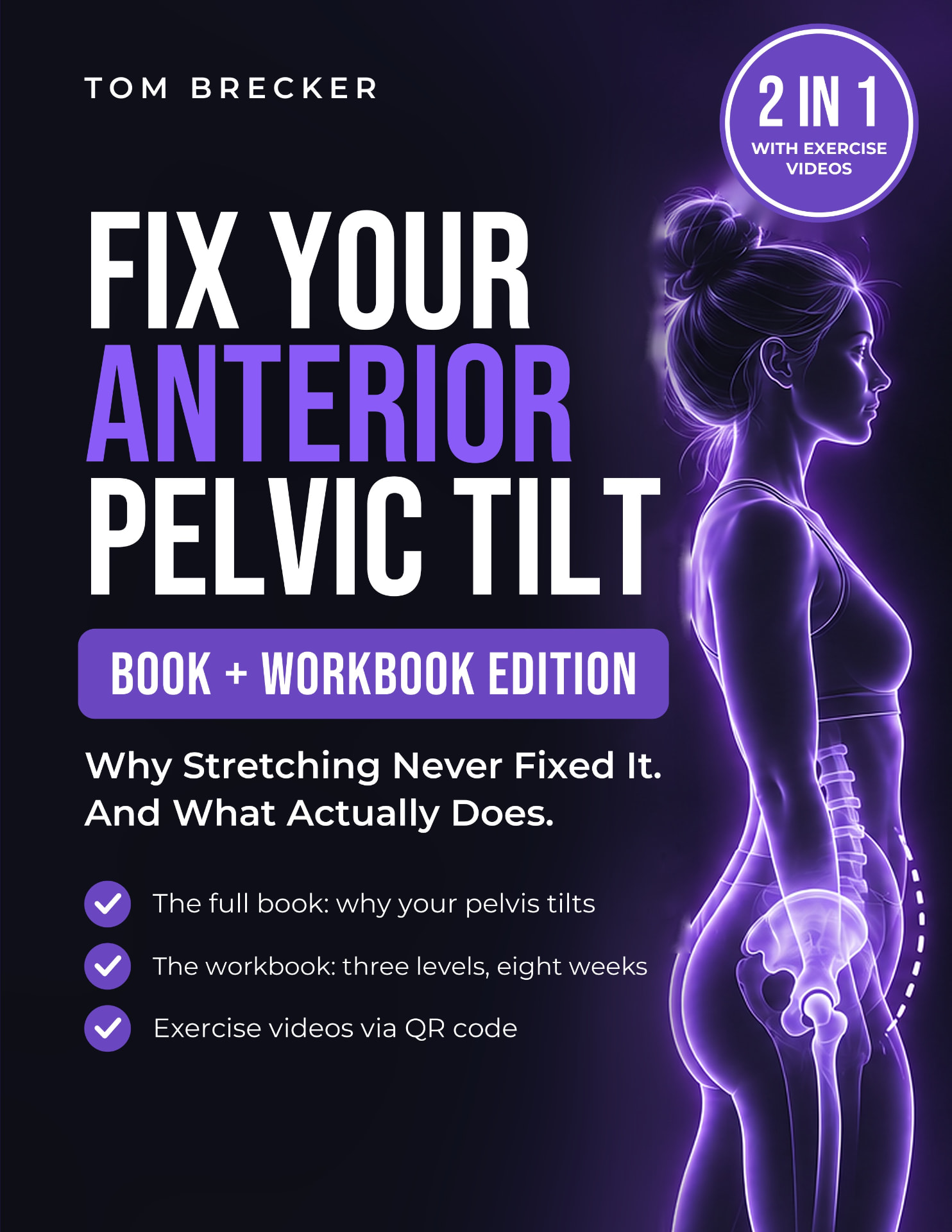
Fix Your Anterior Pelvic Tilt: Book + Workbook Edition
For the position part of your belly, this is the full system:
- The book: why the pelvis tips forward, the Evasive Training Pattern, the stress and breathing connection, and the daily micro habits for the hours outside your workout
- The workbook: baseline tests, three training tracks (Beginner, Standard, Advanced), illustrated exercises, video demos via one tap or QR code, and an 8-week tracker
- A separate printable tracker in US Letter and A4
Please note: this book is about posture, movement and daily habits. It does not diagnose or treat bloating, digestive conditions or any other medical condition.
Get the Book + Workbook ($19.99)Prefer the paperback? Get it on Amazon
Educational self-help, not medical treatment. Results vary from person to person.
Frequently asked questions
Why does my belly get bigger throughout the day?
Common reasons include food and gas, fluid, constipation, hormonal changes and posture. Research also shows that in many people with functional bloating, the visible swelling comes mainly from how the diaphragm and belly wall respond to a full gut, not just from more gas. If it happens most days for three weeks or more, see a doctor.
Can anterior pelvic tilt make you look bloated?
It can make the lower belly look bigger when you stand, because a forward-tilted pelvis pushes the lower belly forward. That is position, not gas. A direct link between anterior pelvic tilt and bloating has not been studied, and many people have both posture and digestive factors.
What is abdomino-phrenic dyssynergia?
It is a term researchers use for a pattern in some people with functional bloating: when the gut fills, the diaphragm contracts and moves down while the belly wall relaxes, so the belly pushes outward. It has been studied mainly in specialist gastroenterology clinics and is diagnosed by doctors, not at home.
Is bloating always caused by gas?
No. Studies in people with functional bloating found that the amount of gas often did not explain how big the belly became. Muscle responses of the diaphragm and belly wall played a large role. Gas, food intolerances, constipation and other conditions can still contribute, so a doctor should assess persistent symptoms.
How can I tell if my belly is bloating or posture?
Compare your waist in the morning and evening, then again lying down. A belly that grows during the day and shrinks clearly when lying down suggests muscle response and position play a role. A large gap behind your lower back in a wall check often goes with a forward-tilted pelvis. This is a rough home check, not a diagnosis.
Do breathing exercises help with bloating?
In a randomized trial, specialist biofeedback training of the breathing and belly wall muscles improved the feeling of bloating clearly more than placebo in patients with functional gut disorders. Simple home breathing exercises have not been tested in the same way, but slow breathing with a longer exhale is low-risk to try.
When should I see a doctor about bloating?
See a doctor if you have bloating on most days for three weeks or more, or bloating with weight loss, blood in your stool, changed bowel habits, feeling full quickly, needing to pee more often, ongoing pain, vomiting, fever or bleeding after menopause. Persistent bloating can be a symptom of ovarian cancer and other conditions.
Does fixing my posture get rid of bloating?
Not necessarily. Working on posture may change how your lower belly sits when you stand, but it does not treat digestive conditions. If your bloating is mainly from gas, food or a medical condition, posture work alone will not solve it.
Sources
- Villoria A, Azpiroz F, Soldevilla A, Perez F, Malagelada JR. Abdominal accommodation: a coordinated adaptation of the abdominal wall to its content. American Journal of Gastroenterology. 2008.
- Villoria A, Azpiroz F, Burri E, Cisternas D, Soldevilla A, Malagelada JR. Abdomino-phrenic dyssynergia in patients with abdominal bloating and distension. American Journal of Gastroenterology. 2011.
- Barba E, Burri E, Accarino A, et al. Abdominothoracic mechanisms of functional abdominal distension and correction by biofeedback. Gastroenterology. 2015.
- Barba E, Accarino A, Azpiroz F. Correction of abdominal distention by biofeedback-guided control of abdominothoracic muscular activity in a randomized, placebo-controlled trial. Clinical Gastroenterology and Hepatology. 2017;15(12):1922-1929.
- Villoria A, Serra J, Azpiroz F, Malagelada JR. Physical activity and intestinal gas clearance in patients with bloating. American Journal of Gastroenterology. 2006.
- Laird RA, Gilbert J, Kent P, Keating JL. Comparing lumbo-pelvic kinematics in people with and without back pain: a systematic review and meta-analysis. BMC Musculoskeletal Disorders. 2014;15:229.
- NHS. Ovarian cancer: symptoms. nhs.uk.
This article is for educational purposes only and is not medical advice, diagnosis or treatment. Tom Brecker is a sports scientist, not a physician. Bloating and back pain can have many causes, some of them serious. If your symptoms are persistent, new, getting worse or come with any of the warning signs above, see a doctor.
Part of the Anterior Pelvic Tilt guide. Read the complete guide to anterior pelvic tilt