
Why Your Tension Headaches Keep Coming Back (And Why It's Not Really Your Neck)
5 October 2026 · 9 min read · Tom Brecker, BSc Sports Science
If you get tension headaches several times a week, you probably know the routine. The tight band around your forehead. The pressure at the base of your skull around 4 pm. The ibuprofen you keep in your bag, your desk and your car. Just in case.
I lived like that for over twelve years. At my worst, I had tension headaches three to four times a week. I tried everything most people try. Some of it helped for a day. None of it lasted.
What finally changed things wasn't a new pill or a better stretch. It was one question I should have asked a decade earlier.
Not "how do I get rid of this headache?"
But "why does this keep happening?"
What a tension headache actually is
A tension-type headache is the most common headache disorder in the world. A large 2022 review in The Journal of Headache and Pain estimated that roughly one in four people worldwide live with it.
It typically feels like:
- A dull, pressing or tightening pain, often on both sides of the head
- A band around the forehead, temples or the back of the head
- Tight, tender muscles in the neck, shoulders or jaw
- Mild to moderate pain that is annoying, draining, but not throbbing
It usually does not come with nausea, vomiting or strong sensitivity to light and sound. Those point more toward migraine. (More on warning signs below.)
When tension headaches happen on 15 or more days a month for more than three months, doctors call them chronic. That's where life quietly starts to reorganize itself around the pain.
Why the usual fixes don't last
Here's the standard playbook most of us run:
- Headache arrives, take ibuprofen
- Neck gets tight, get a massage
- It gets bad enough, see a physio
- Someone says "it's just stress," try to "stress less"
- Repeat
Every step on that list targets the output: the pain, the tight muscle, the sore spot. None of them directly addresses the input: whatever keeps loading your neck day after day.
That may be why the relief feels real but often doesn't last. Massage released what had built up. For me, the tension was back by the end of the week. I would have needed a massage every single day to keep up. That's not a fix. That's maintenance.
The painkiller trap nobody warns you about
Painkillers are useful. But there are two problems with relying on them several times a week:
1. They silence the messenger. If the headache is a signal, muting it every time makes it harder to notice what it's pointing at.
2. Too much can make headaches worse. Headache specialists recognize a condition called medication-overuse headache. Under the international classification (ICHD-3), taking simple painkillers like ibuprofen or paracetamol on 15 or more days a month for over three months can itself drive more frequent headaches. The cure quietly becomes part of the cause.
If you're counting more pills than you'd like to admit, that's worth a conversation with your doctor. Never stop or change prescribed medication on your own.
What I eventually noticed: a pattern of bracing
Here's the part that changed everything for me.
For me, the bigger issue wasn't simply my neck. I started noticing how strongly my body responded to discomfort by bracing.
Every time something felt uncomfortable (a deadline, a tense conversation, a crowded train, an email I was dreading), my body did the same thing: it braced. Shoulders up. Neck pulled tight. Jaw slightly clenched. Breath high and shallow.
Not dramatically. Quietly. Automatically. Dozens of times a day.
I call this the Evasive Pattern: my own term for the way I learned to brace automatically whenever I felt discomfort or stress. It's not a medical diagnosis. It's the model that finally helped me make sense of my headaches. My best guess is that bracing once helped me get through something, and then it simply never switched off.
And here's what surprised me most: it didn't even need a real stressor. Just thinking about a difficult conversation was enough to tighten my neck. Before anything had happened. Sometimes before I'd consciously noticed I was worried.
In my case, the tension built all day, below my awareness. By the time the headache arrived in the evening, whatever started it had happened hours earlier.
For me, the headache turned out to be the last link in a chain that started much earlier.
Where it shows up first
If this sounds familiar, notice where the bracing shows up first for you:
- Shoulders creep toward your ears at the laptop
- Jaw clenches when you read a stressful message
- Grip tightens on the steering wheel in traffic
- Breath goes shallow in meetings
- Eyes narrow and forehead tightens when you concentrate
Knowing where it starts tells you where to look.
The one metric that matters more than headache frequency
Most people track one thing: how many headaches did I have this week?
That number is noisy. It swings with sleep, workload, weather, hormones and a dozen other things you don't control. Judge your progress by it and you'll quit in week three, right before things start changing.
The metric that moved first for me was something else entirely: catch-time.
Catch-time is how early you notice the tension building.
- Late: you only notice when the headache is already there
- Mid: you notice when the neck starts to tighten, an hour or two before
- Early: you notice at the moment of the trigger, before the neck is tight
When I started, I caught it at 8 pm, with the headache already pounding. Months later, I was catching my shoulders rising at 2 pm, in the middle of the meeting that caused it. For me, that shift showed up before my headache frequency dropped. It was the first sign that something was changing.
In the workbook I built around this, catch-time is one of the four starting numbers you measure on day one. It's also the one most people have never heard of.
3 things you can try today
These won't fix the pattern on their own. But they may help you notice how your neck responds when you change the input.
1. The 10-second redirect
Next time you notice tension, do three things:
- Drop your shoulders away from your ears
- Gently engage your lower belly, just enough to feel it switch on
- Take one slow breath with a longer exhale than inhale
That's one rep. For me, giving my body something else to do, like gently activating the lower belly, made it much easier to let go of my neck than simply telling myself to relax.
Want to see it? Watch the Shoulder Drop video and The Long Exhale.
2. Micro-moments instead of one long session
For me, short check-ins throughout the day were easier to apply consistently than one long relaxation session. The bracing happened during my normal day, so that's where I needed to catch it.
Attach a check to things you already do: every red light, every time you unlock your phone, every time the kettle boils. Where are my shoulders right now?
3. Fix the last ten minutes before sleep
Sleep and pain are closely linked. Scrolling right up until you fall asleep can make it harder to wind down, and poor sleep can lower your pain threshold the next day. A study in the Journal of Sleep Research found that disrupting deep sleep measurably increased pain sensitivity, and recovery sleep reversed it.
Try this for one week: phone out of the bedroom ten minutes before sleep, neutral sound, and one honest thought about something that went okay today. If waking up stiff is part of your pattern, also check your pillow. A hard pillow can hold your neck in a loaded position for eight hours.
For a guided version, try the neck and shoulder reset and the breathing reset.
Why knowing this isn't enough (the part most guides skip)
Here's the uncomfortable truth: you can read every word of this article, agree with all of it, and still have a headache on Thursday.
Because understanding a habit doesn't change it. Repetition does. In my experience, the bracing was learned through thousands of repetitions, and it took repetition to change it: one noticed moment, one dropped shoulder, one slow breath at a time, until the new response started to feel automatic.
That's the gap where most people fall off. Not because they're lazy, but because they have no structure. No way to see progress. No plan for the week when everything falls apart and the headaches come back.
That's exactly why I built a 30-day system around it.
Fix Your Tension Headaches: Book + Workbook Edition
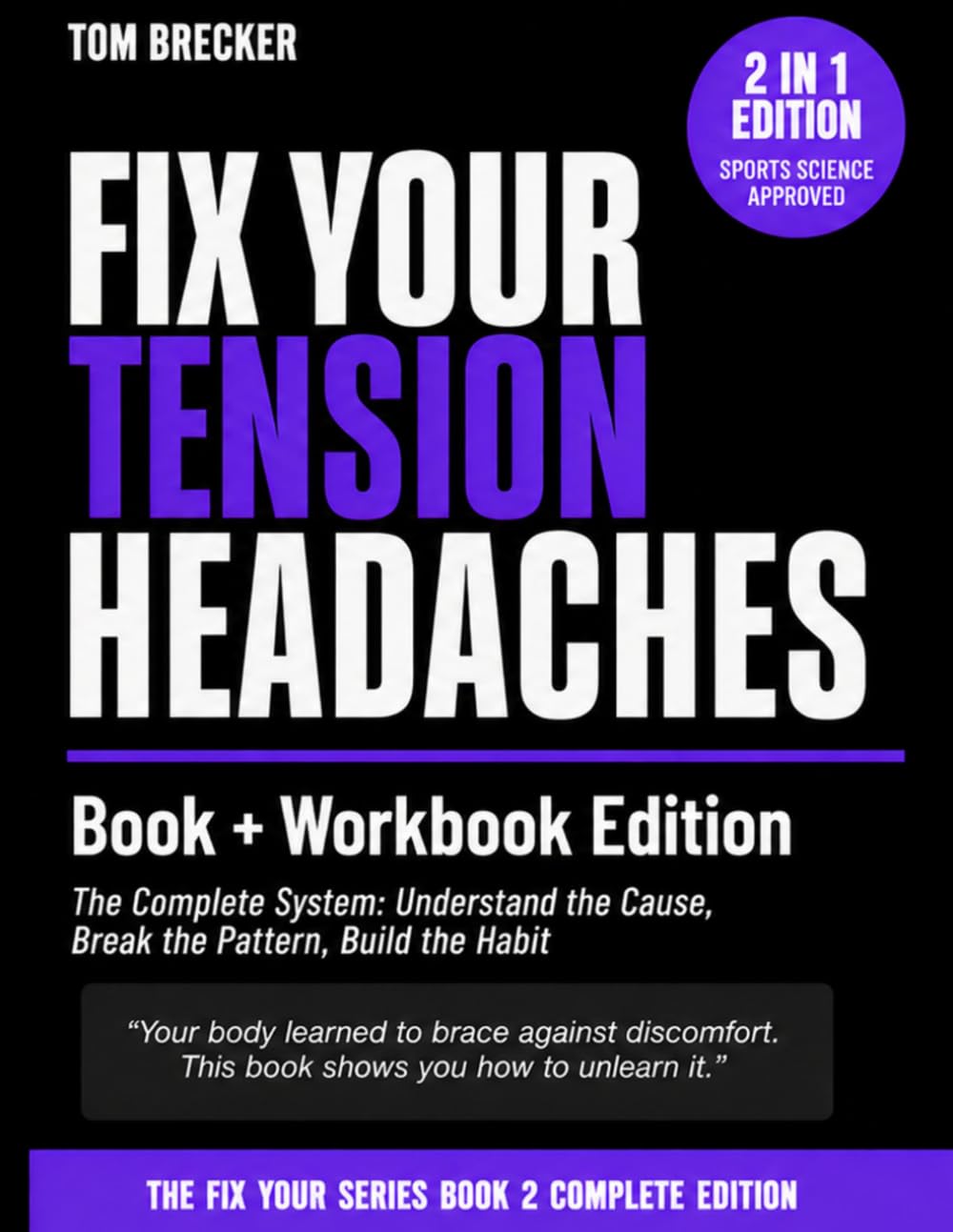
It's the full story behind everything above, plus the practical system to actually run it:
- The book: the Evasive Pattern, the painkiller trap, trigger point work done safely at home, the sleep transition, and what real progress looks like (including the three kinds of setbacks almost everyone hits)
- The workbook: your Headache Profile with four starting numbers, a trigger inventory, your personal pattern map, and a 30-day tracker that adds one layer at a time
- A separate printable tracker in US Letter and A4, so you only print what you need. Or fill it in on your tablet.
Get Fix Your Tension Headaches: Book + Workbook Edition ($19.99)
Instant PDF download. Start with the 5-Minute Relief Reset tonight.
Not ready yet? Start with the free 7-Day Body Reset and see how your neck responds.
When a headache is NOT a tension headache
Please see a doctor promptly, and seek emergency care for the first two, if your headache:
- Comes on suddenly and severely, like a thunderclap or "the worst headache of my life"
- Comes with fever, stiff neck, confusion, weakness, numbness, slurred speech or vision loss
- Starts after a head injury
- Is new after age 50, or has clearly changed in pattern or severity
- Wakes you from sleep, or gets worse when you cough, strain or lie down
- Comes with nausea, vomiting or strong light sensitivity (this may be migraine, which needs a different approach)
Everything in this article assumes your doctor has ruled out other causes.
The bigger picture: it's rarely just your head
In my experience, the bracing didn't stop at my neck. I recognized it in the constant low-level stress that never quite switches off (read: Tired but Wired). It may also explain why some nervous system "resets" felt useless to me (read: your reset isn't working because you're doing the wrong one).
I noticed it in my posture too. It's part of the same story behind my anterior pelvic tilt.
If stress is clearly your biggest trigger, start with the Stress & Cortisol guide. For everything about tension headaches in one place, see the complete Tension Headaches guide.
FAQ
What is the main cause of recurring tension headaches?
Recurring tension headaches are usually driven by a combination of factors: stress, muscle tension in the neck, shoulders and jaw, poor sleep and a lowered pain threshold. For some people, a habit of bracing automatically under stress may be one part of what keeps the cycle going.
Why do my tension headaches start in the afternoon or evening?
One common explanation is that stress and muscle tension build up gradually over the day. The headache may appear in the late afternoon or evening, hours after the situations that contributed to it.
Can taking ibuprofen too often make headaches worse?
Yes, it can. Taking simple painkillers on 15 or more days a month for over three months can lead to medication-overuse headache, according to the international headache classification (ICHD-3). If you rely on painkillers several times a week, talk to your doctor before changing anything.
Does massage help tension headaches?
Massage can relieve accumulated tension and reduce pain for a day or two. On its own, it often doesn't change what builds the tension up again, so the relief may fade. It can be one useful tool alongside daily habit changes.
How long does it take to reduce tension headaches naturally?
It varies a lot from person to person. Some people notice that they catch tension earlier before they notice any change in how often headaches happen. If your headaches don't improve, or get worse, talk to a doctor.
Can poor sleep cause tension headaches?
Poor sleep can lower your pain threshold, so the same amount of neck tension is more likely to turn into a headache the next day. Headaches can also disrupt sleep, which creates a loop. Improving the transition into sleep is one of the most underrated levers.
What can I try when I notice a tension headache starting?
Some people find it helpful to lower the shoulders, relax the jaw, take a few slow breaths with longer exhales, and apply gentle pressure to tight spots at the base of the skull or temples. If the headache is unusual for you, gets worse or doesn't ease, see a doctor.
Is a tension headache dangerous?
Typical tension headaches are not dangerous, but they can seriously affect quality of life. A sudden severe headache, or one with fever, stiff neck, confusion, weakness or vision changes, needs urgent medical attention.
Sources
- Stovner LJ et al. The global prevalence of headache: an update, with analysis of the influences of methodological factors on prevalence estimates. J Headache Pain. 2022;23:34.
- Headache Classification Committee of the International Headache Society. The International Classification of Headache Disorders, 3rd edition (ICHD-3). Cephalalgia. 2018;38(1):1-211.
- Fernández-de-las-Peñas C et al. Trigger points in the suboccipital muscles and forward head posture in tension-type headache. Headache. 2006;46(3):454-460.
- Onen SH et al. The effects of total sleep deprivation, selective sleep interruption and sleep recovery on pain tolerance thresholds in healthy subjects. J Sleep Res. 2001;10(1):35-42.
This article is for educational purposes and is not medical advice. Tom Brecker is a sports scientist, not a physician.
Part of the Tension Headaches guide. Read the complete guide to tension headaches
Free · Seven days · Five minutes a day
Start with day one
Twelve questions, one number, and the Recovery Window. A starting point you can measure against in four weeks.