
Anterior Pelvic Tilt From Sitting: Why Your Desk Job Shows Up When You Stand
7 October 2026 · 7 min read · Tom Brecker, BSc Sports Science
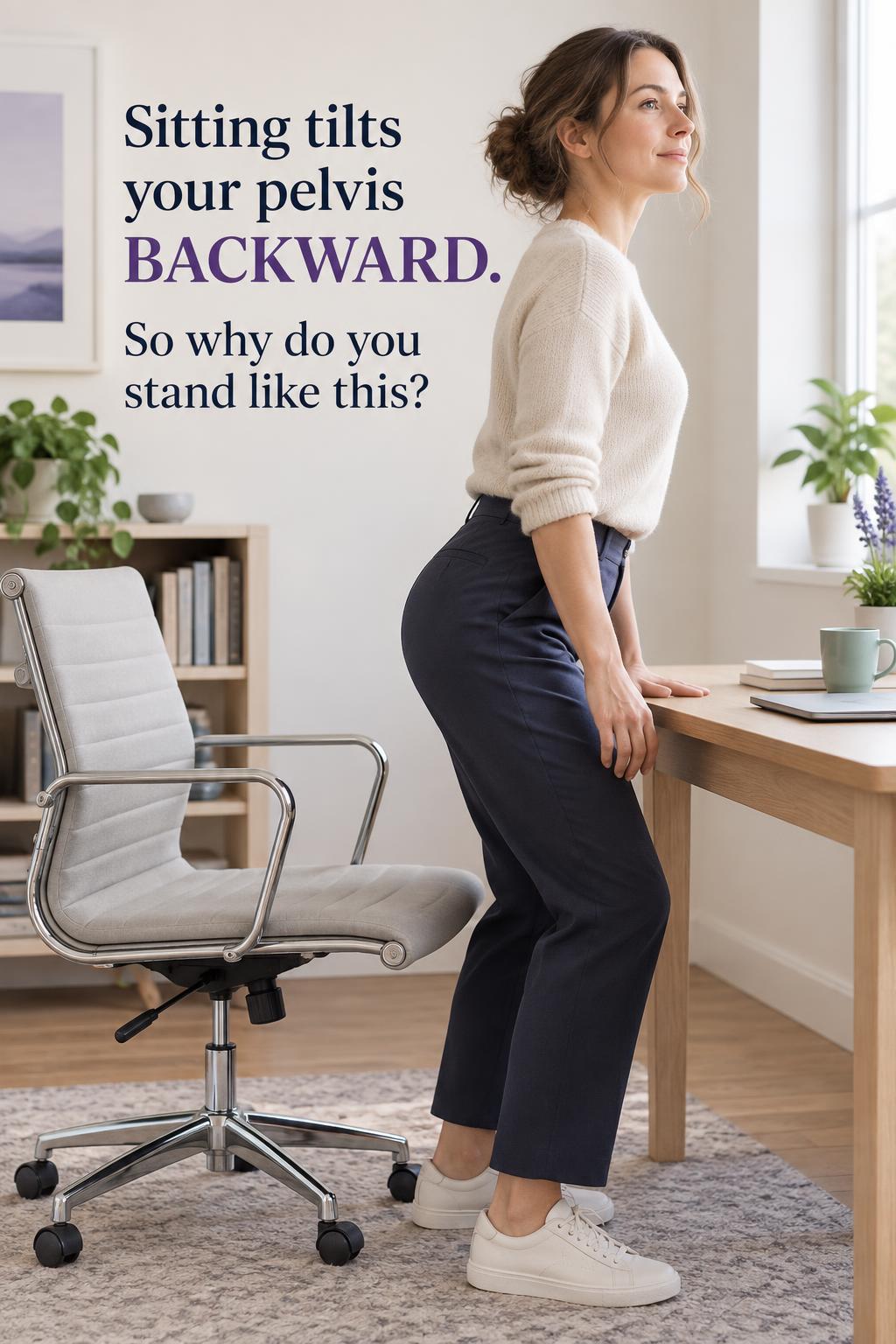
If you work at a desk, you've probably read that "sitting causes anterior pelvic tilt."
Here's the strange part: when researchers actually X-rayed people sitting and standing, the pelvis did the opposite of what you'd expect.
That paradox is the key to understanding why stretching your hip flexors after work often changes so little.
The sitting paradox
In a 2015 radiographic study, researchers compared the lower back and pelvis of 30 healthy adults standing and in five different sitting positions (Cho et al., 2015).
Standing, the average lower back curve was about 47 degrees. Sitting on a normal 90-degree chair, it dropped to about 18 degrees. On a stool or cross-legged, the curve almost disappeared or even reversed. And as the curve flattened, the pelvis rolled backward.
In other words: while you sit, your pelvis is in a backward tilt.
So if sitting rolls the pelvis back, why do so many people who sit all day stand with their pelvis tipped forward, their lower back arched and their belly pushed out?
What changes when you stand up
Here's the most common explanation, and I want to be clear that it's a working model, not settled science.
When you sit, your hips are bent at roughly 90 degrees for hours. The muscles at the front of your hips (the hip flexors) spend that whole time in a shortened position. The glutes, which should help keep your pelvis level when you stand, do almost nothing.
Then you stand up. And the body seems to keep some of that seated setting:
- The front of the hips may stay stiff and pull the pelvis forward
- The glutes stay quiet instead of switching on
- The lower back takes over to hold you upright, and arches
That's when anterior pelvic tilt shows up. Not in the chair. In the hallway, at the coffee machine, in the mirror.
That matched my own experience exactly. I've lived with anterior pelvic tilt since at least 2012, and for years I sat 8 to 10 hours a day. My posture never looked bad in the chair. It looked bad every single time I stood up from it.
Try this today: the after-sitting check
You can test this on yourself.
- Do the wall gap test in the morning, before you've sat for long. Note how much space there is behind your lower back.
- Do it again right after your longest sitting block of the day.
If the gap is noticeably bigger after sitting, your seated hours are likely part of your pattern. That's useful information, because it tells you when to intervene.
How much are we actually sitting?
More than we think. A large study published in JAMA found that the average American adult's daily sitting time rose from about 5.5 hours in 2007 to about 6.4 hours in 2016 (Yang et al., 2019). That's before remote work became normal for millions of people.
Now compare that to your workout. Even a good anterior pelvic tilt routine takes 10 to 20 minutes. That's roughly 20 to 40 times less than the time you spend in the position that sets you up for it.
This is why so many people do their glute bridges and hip flexor stretches faithfully and still see no change. The exercises aren't wrong. They're just outnumbered.
Why stretching after work isn't enough
The obvious fix sounds like: sit all day, stretch your hip flexors in the evening.
It helps a bit. But it has two problems.
1. It comes too late. By evening, you've already stood up and sat down dozens of times in the old pattern. Each of those moments was practice.
2. Stretching doesn't wake up the glutes. You can lengthen the front of the hip, but if the glutes still don't switch on when you stand, the lower back keeps doing their job.
There's a third problem that took me years to see. Even when I did train my glutes, my body found ways to do the exercises without really using them. I call this the Evasive Training Pattern, and I wrote about it in how long it takes to fix anterior pelvic tilt.
The 2 seconds that matter most
Here's the part most guides miss completely.
If the problem shows up when you stand up, then the most important moment of your day isn't your workout. It's the transition: the two seconds between sitting and standing, which happens 30, 50, maybe 70 times a day.
What you do in those two seconds, repeated dozens of times a day for a few weeks, may matter more than anything you do on a mat.
The single habit that made the biggest difference for me happens exactly in that moment. It takes no extra time, nobody around you notices it, and once you know it, it's almost too simple. It's the first of the daily micro-habits in my book, and the one I'd keep if I could only keep one.
3 things you can start today
These are safe, simple starting points:
- Break up your sitting. Stand up at least every 30 to 60 minutes, even for a minute. Each break interrupts the seated position, and each stand-up is a chance to practice standing differently.
- Use back support when you sit. In the 2015 study, sitting on a chair with lower back support changed the spine's natural curve the least. A small cushion behind your lower back is an easy start.
- Stretch the front of your hips in the evening. A gentle half-kneeling hip flexor stretch, 30 seconds per side, with your pelvis slightly tucked. You'll find it, with 15 other key exercises, on the anterior pelvic tilt exercise poster.
They'll help. What they won't do on their own is change what your body does every time you stand up.
The complete system: Fix Your Anterior Pelvic Tilt (Book + Workbook)
If you sit a lot, you don't need a longer workout. You need a plan for the whole day, especially the moments between sitting and standing.
That's exactly what this bundle is built around:
Inside the book:
- Why anterior pelvic tilt feels "normal" to your body, and why that makes it so hard to change
- The Evasive Training Pattern, and how to stop your body from routing around the muscles that matter
- The two exercises that matter most, and how to do them so the right muscles actually work
- The daily micro-habits for the 950+ minutes outside your workout, including the one for the moment you stand up from a chair
- Sitting, sleep position, stress and the other everyday factors that keep pulling you back
- A complete 8-week reset plan
Inside the workbook:
- Baseline tests so you can see real progress
- 3 tracks (Beginner, Standard, Advanced) so you start where your body is today
- A micro-habit builder that attaches each habit to something you already do
- An 8-week tracker, plus a separate printable version in US Letter and A4
About 8 minutes of exercise a day. The rest happens while you live your normal day.
Get Fix Your Anterior Pelvic Tilt: Book + Workbook Edition ($19.99)
Instant PDF download. Start with the after-sitting check today.
Want something smaller first? The printable exercise poster shows all 16 key exercises at a glance. Or start with the free 7-Day Body Reset.
Related reading
- Anterior Pelvic Tilt: Exercises, Causes & What Actually Helps: the complete guide
- How long does it take to fix anterior pelvic tilt?
- Why your lower belly sticks out (even when you're not gaining weight)
- Skinny fat or anterior pelvic tilt?
- Guided resets: Pelvic Tilt · Glute Bridge · Plank
FAQ
Does sitting cause anterior pelvic tilt?
Not directly. While you sit, your pelvis actually tilts backward and your lower back flattens. A common explanation is that long hours of sitting leave the hip flexors stiff and the glutes underused, so the pelvis tilts forward once you stand up. Research directly linking sitting time to anterior pelvic tilt is limited, but long sitting is a very common pattern in people who have it.
Why does my lower back arch more after sitting all day?
After long sitting, the front of the hips can feel stiff and the glutes may not switch on right away when you stand. The lower back often takes over to hold you upright, which increases the arch. Standing up regularly and paying attention to how you stand up can help.
What is the best sitting position for anterior pelvic tilt?
In a 2015 X-ray study, sitting on a chair with lower back support changed the natural curve of the spine the least compared with other sitting positions. Sitting with back support and changing position often is a reasonable starting point.
How often should I stand up if I have anterior pelvic tilt?
There is no exact number proven for anterior pelvic tilt. Standing up at least every 30 to 60 minutes is a practical goal, and each time you stand up is a chance to practice a more neutral standing position.
Will a standing desk fix anterior pelvic tilt?
A standing desk can reduce sitting time, but it won't fix anterior pelvic tilt on its own. Many people simply stand in the same tilted position for longer. Alternating between sitting and standing, and working on how you stand, matters more than the desk itself.
Can I fix anterior pelvic tilt if I have a desk job?
Yes. Many people with anterior pelvic tilt have desk jobs. The key is not only exercise but also small daily habits: breaking up sitting, how you stand up from a chair, and how you stand during the day. Change takes time, typically weeks to months.
Is hip flexor stretching enough for anterior pelvic tilt from sitting?
Usually not. Stretching can help the front of the hips feel freer, but it doesn't train the glutes and deep core to switch on when you stand. Most people need a combination of stretching, strengthening and daily habit changes.
Sources
- Cho IY, Park SY, Park JH, Kim TK, Jung TW, Lee HM. The Effect of Standing and Different Sitting Positions on Lumbar Lordosis: Radiographic Study of 30 Healthy Volunteers. Asian Spine J. 2015;9(5):762-769.
- Yang L, Cao C, Kantor ED, et al. Trends in Sedentary Behavior Among the US Population, 2001-2016. JAMA. 2019;321(16):1587-1597.
This article is for educational purposes and is not medical advice. If you have back pain that radiates into your legs, numbness, or pain after an injury, see a healthcare professional. Tom Brecker is a sports scientist, not a physician.
Part of the Anterior Pelvic Tilt guide. Read the complete guide to anterior pelvic tilt
Free · Seven days · Five minutes a day
Start with day one
Twelve questions, one number, and the Recovery Window. A starting point you can measure against in four weeks.