
Does anterior pelvic tilt cause lower back pain? What the research actually says
13 November 2026 · 9 min read · Tom Brecker, BSc Sports Science · Not a doctor or physical therapist
Educational information, not medical advice. I am not a doctor or physical therapist. If your back pain is severe, new after 50, not improving, or comes with any warning sign below, please get it checked. This article mentions my own book.
At some point, someone probably told you that your back hurts because of your posture.
Maybe it was a chiropractor pointing at an X-ray. A trainer watching you squat. A friend who said, kindly, "your lower back arches too much." And it made sense. Your lower back arches, your belly sits forward, and your back aches at the end of the day. Case closed.
Then you did the stretches. You tucked your pelvis under every time you remembered. And your back kept aching anyway.
Here is the part most posture content leaves out: when researchers actually measure people with and without back pain, the curve of the lower back turns out to explain surprisingly little. Something else shows up much more clearly, and it changes what is worth your time.
I am a sports scientist (BSc), not a doctor, and I have lived with anterior pelvic tilt for more than a decade. This article is what I wish someone had shown me before I spent years trying to hold my pelvis in a "correct" position.
Check this first
Call 911 (or your local emergency number) or go to the emergency room right away if back pain comes with:
- Numbness or tingling around your genitals, buttocks or inner thighs, or a new loss of feeling during sex
- New trouble urinating (including not being able to pee), or losing control of your bladder or bowels
- Sudden or quickly worsening weakness in one or both legs, a foot that drags or slaps, or trouble walking
- Sudden, severe back or belly pain that feels tearing or ripping, especially with dizziness, fainting, a pulsing feeling in your belly, chest pain or shortness of breath
- Back pain after a serious injury, such as a car crash or a hard fall, or if you cannot stand or walk
See a doctor promptly (within a few days, or the same day if you have a fever), and do not start a new exercise program first, if you have:
- Back pain after a fall, accident or other injury
- Fever, chills or feeling very unwell with back pain, especially after a recent infection (such as a urinary tract infection), a spinal injection or surgery
- Weight loss you cannot explain
- A history of cancer (even if treated years ago), osteoporosis, or taking steroid pills such as prednisone for more than a few months
- Sudden back pain after a minor strain, cough, sneeze or lift if you have osteoporosis or low bone density
- Back pain that starts for the first time after age 50
- A weakened immune system (for example from chemotherapy, an organ transplant or immune-suppressing medicines), or injecting drugs
- Being pregnant or having given birth recently
- Numbness, tingling or pain that spreads down a leg, especially below the knee
- Pain that is constant, gets worse at night, wakes you from sleep or does not ease when you lie still
- Pain that keeps getting worse, or has not improved after 4 to 6 weeks
Most back pain is not caused by anything serious and settles with time. These signs are less common, but they need a professional to look at them before you work on posture. If you are not sure whether something is urgent, call your doctor's office or a nurse line.
First: a forward-tilted pelvis is common in people with no pain at all
If anterior pelvic tilt reliably caused back pain, you would expect people without back pain to mostly stand with a level pelvis. They do not.
In a study of 120 young adults without back pain (average age about 24), about 85% of the men and 75% of the women had a measurable forward tilt (Herrington, 2011). In that group, a forward tilt was the norm rather than a rare defect.
There is a second problem. Pelvic bones vary so much in shape that the usual way of measuring tilt from the outside can be misleading. One study of pelvic bones from body donors found that differences in bone shape alone could make the same posture look tilted in one person and level in another (Preece et al., 2008). So when someone glances at you from the side and says your pelvis is "out", they may be looking partly at your skeleton, not your habits.
Not sure where you stand? The anterior pelvic tilt test guide walks through four home checks and how often they are misread.
What the studies comparing people with and without back pain found
This is the core of it. Several research teams have asked the obvious question: do people with low back pain stand with a bigger lower-back curve than people without?
The curve barely differed. A systematic review and meta-analysis pooled studies that measured the lower back in people with and without back pain. In standing, the lower-back curve was not meaningfully different between the groups. What did differ was movement: people with back pain had less range of motion, moved more slowly and were less accurate at sensing the position of their lower back (Laird et al., 2014).
If anything, the link points the other way. A second meta-analysis found that people with low back pain tended, on average, to have a somewhat flatter lower-back curve on X-ray than people without pain, not a deeper one. The link was strongest in people with disc herniation or disc degeneration, and small when groups were matched for age. A study like this shows an association; it cannot tell us whether the flatter curve came before or after the pain (Chun et al., 2017).
Endurance mattered more than angles. In an earlier study of 600 people, the researchers measured a long list of physical factors, including pelvic tilt and the lower-back curve. Neither was linked to back pain. The strongest link was with weaker endurance in the back muscles, along with back muscle length and the strength of some hip and belly muscles. Hip flexor length was not linked. Because this was a one-time comparison, it cannot show cause (Nourbakhsh and Arab, 2002).
The big picture is "no consensus". A 2020 review that looked across many systematic reviews concluded that the evidence does not establish spinal posture as a cause of low back pain (Swain et al., 2020).
The angle you stand at seems to matter less than whether you can move out of it.
That matched my own experience exactly. The problem was never one "bad" angle. It was being stuck: one position for standing, one for sitting, a lower back that did all the work and glutes that barely joined in.
So is anterior pelvic tilt irrelevant? Not quite.
"Posture does not reliably predict pain across large groups" is not the same as "posture never matters for anyone". Group averages can hide individual patterns.
One area where this shows up is long periods of standing. When researchers had people without a history of back pain stand for two hours, some of them developed back discomfort and others did not. Those who developed it tended to have different patterns of muscle activity around the hips and trunk, the hip muscles on both sides (gluteus medius) and the front and back trunk muscles were switched on together more often, and this showed up before the discomfort started. The researchers suggested it may be a risk pattern rather than a reaction to pain (Nelson-Wong and Callaghan, 2010).
That fits what many readers describe: the ache that builds while cooking, standing in line or at a standing desk, and eases when they sit down or lean forward a little. If that sounds like you, your posture may be one piece of your picture. But the more promising lever is variety and capacity, not forcing your pelvis into a fixed position and holding it there.
One caveat: if the pain also spreads into your buttocks or legs, or your legs feel heavy, numb or weak when you stand or walk and recover when you sit or bend forward, tell your doctor. In people over 50 that pattern can come from narrowing in the spine (spinal stenosis), not posture.
If you sit most of the day and stand with a tilt, read why sitting shows up when you stand.
A two-minute self-check (an observation, not a diagnosis)
These are simple things to notice. They cannot tell you what causes your pain. Skip them if any warning sign above applies, if you are in a flare of severe pain, or if you have had back, hip or belly surgery recently (including a C-section) and have not been cleared to exercise. If you are pregnant, ask your provider first; after the first trimester, avoid long spells lying flat on your back. If you have osteoporosis or have had a spine fracture, check with your doctor first. Stop if anything causes pain, or numbness or tingling that spreads into a leg. Lying on a firm bed is fine if getting down to the floor is hard.
- Can you move your pelvis both ways? Lie on your back with your knees bent. Slowly flatten your lower back into the floor, then let it arch gently away. Keep the arching small; if arching brings on pain or leg symptoms, skip that direction. In my experience, many people with a forward tilt find the flattening direction harder to find and control. You can follow along with the guided pelvic tilt reset.
- Does the ache change with position? Notice whether a standing ache eases when you shift your weight, put one foot on a low step or sit for a minute. A clear link to position is useful information to share with your doctor or physical therapist, especially if leg symptoms are part of it.
- Where do you feel a glute bridge? Do a slow glute bridge and ask yourself where you feel it most. If it is mainly your lower back or hamstrings, it may be worth practicing bridges with more focus on the glutes. This is a rough cue, not a measurement. I wrote more about this in why APT exercises sometimes do not seem to work.
What has the best evidence for long-lasting low back pain
Here is the honest summary, and it is less exciting than most posture content.
- Exercise helps modestly on average. A large Cochrane review found that exercise therapy probably reduces pain compared with no treatment, usual care or placebo for long-lasting low back pain. On average, pain dropped by about 15 points on a 0 to 100 scale, and the effect on day-to-day function was small. A companion analysis by the same team found some types, such as Pilates and McKenzie-based exercise, did somewhat better, and the authors suggest choosing exercise you enjoy and will keep doing (Hayden et al., 2021).
- Clinical guidelines support exercise and staying active. The UK's NICE guideline advises clinicians to consider a group exercise program (strength-based, aerobic, mind-body such as yoga, or a mix) for an episode or flare-up of low back pain, choosing the type based on the person's needs, preferences and abilities, rather than one prescribed "correct" method (NICE, 2016, updated 2020).
- "Sit up straight" is not the evidence-based message it sounds like. A group of back pain researchers have argued that there is no single correct posture, that people with back pain are often more guarded and less relaxed in how they sit and move, and that the message to keep trying to hold one "perfect" posture is not supported by evidence (Slater et al., 2019).
Put together, this suggests a different goal for working on anterior pelvic tilt. Not "get the angle right and hold it", but:
- Learn to move your pelvis in both directions with control
- Build endurance in the glutes and trunk muscles, gradually
- Change position often during the day, especially during long standing or sitting
- Treat your next position as your best position, rather than hunting for a perfect one
Progress with this is slow and individual. If you want a realistic idea of what changes first, read the honest timeline for anterior pelvic tilt.
Want a reminder on the wall? My free APT exercise poster shows the basic moves on one printable page.
If you want a structured plan for the posture side
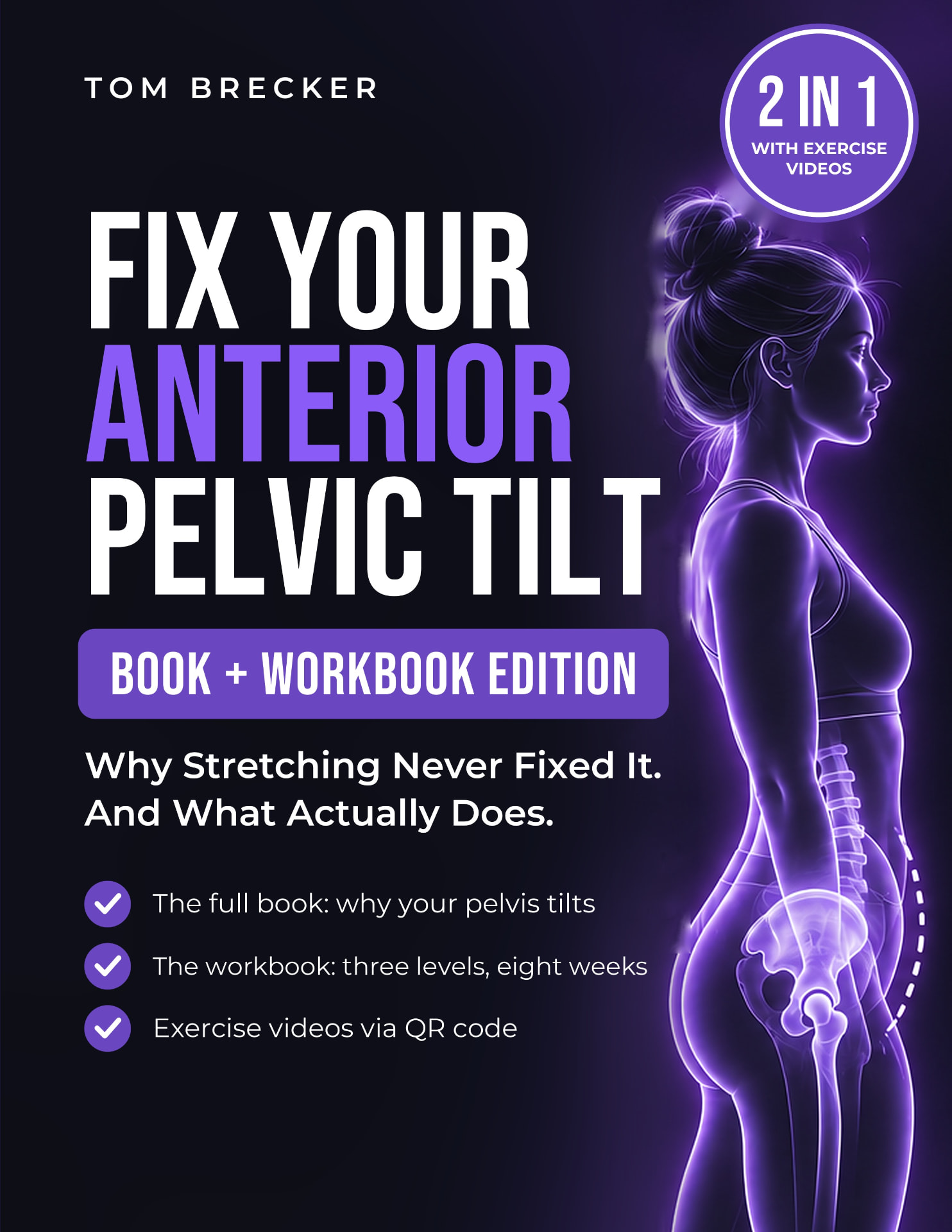
Fix Your Anterior Pelvic Tilt is my book and workbook on posture and movement for people who sit a lot. It builds on the movement principles described above (the studies cited were not done on this book): moving the pelvis with control, building glute and trunk endurance, and small habits for the hours outside your workout. It includes the Wall Gap Test to track your own progress, an 8-week plan with three levels per exercise (Beginner, Brecker-Standard, Pro), illustrations and video demos.
It is an exercise and education program. It is not a back pain treatment, and it does not diagnose or treat any medical condition. If you have back pain, get it checked first and ask your doctor or physical therapist whether the exercises suit you. Results vary.
I wrote this book and earn money when you buy it.
Instant PDF download.
Frequently asked questions
Does anterior pelvic tilt cause lower back pain?
Not on its own, as far as research can tell. Many people without any back pain have a forward-tilted pelvis, and studies comparing people with and without back pain do not find a bigger lower-back curve in those with pain. If anything, it tends to be slightly flatter. How freely and how quickly people move seems to differ more than the angle they stand in.
Is anterior pelvic tilt bad for you?
A small forward tilt is normal. In a study of 120 young adults without back pain, most men and women had some measurable anterior tilt. It becomes worth looking at when you feel stuck in one position, when one direction of movement is hard, or when you notice a pattern between how you stand and how your back feels.
Can working on my posture relieve back pain?
It may help some people as part of a broader approach, but no posture program can promise that. Exercise is one of the best-supported treatments for long-lasting low back pain. No single type is clearly best for everyone, and the exercise you will actually keep doing matters a lot. Moving more often and more freely seems to matter more than holding one ideal posture.
Why does my lower back ache when I stand for a long time?
Standing still for a long time is a common trigger for a dull lower back ache, even in people without a back problem. Studies on prolonged standing suggest that people who develop pain tend to switch on opposing hip and trunk muscles at the same time. Shifting your weight, putting one foot up on a step and taking short walking breaks are simple things to try. If standing or walking also brings on pain, heaviness or numbness in your legs, see a doctor rather than treating it as a posture problem.
Should I stretch my hip flexors if my lower back hurts?
Gentle hip flexor stretches feel good for many people, but there is no strong evidence that stretching alone changes posture or back pain, and in one large study hip flexor length was not linked to back pain. If a stretch increases your pain, stop. Combining gentle mobility with strength work for the glutes and trunk is a more complete approach.
When should I see a doctor about lower back pain?
Call 911 (or your local emergency number) for numbness around the genitals, buttocks or inner thighs; new trouble peeing or controlling your bladder or bowels; sudden or worsening weakness in a leg; sudden severe tearing back or belly pain; or pain after a serious injury. Get care the same day if you have back pain with fever or chills. See a doctor soon if your pain started after a fall or minor strain and you have osteoporosis, if you have unexplained weight loss, a history of cancer, long-term steroid use or a weakened immune system, if it is your first back pain after age 50, if numbness or pain spreads down a leg, if the pain is worse at night or at rest, or if it keeps getting worse or has not improved after 4 to 6 weeks.
Related reading
- Anterior pelvic tilt: the complete guide
- Why your lower belly sticks out (even when you are not gaining weight)
- Anterior pelvic tilt test: 4 ways to check at home
- How long it takes to change anterior pelvic tilt
Sources
- Herrington L. Assessment of the degree of pelvic tilt within a normal asymptomatic population. Manual Therapy. 2011;16(6):646-648.
- Preece SJ, Willan P, Nester CJ, Graham-Smith P, Herrington L, Bowker P. Variation in pelvic morphology may prevent the identification of anterior pelvic tilt. Journal of Manual & Manipulative Therapy. 2008;16(2):113-117.
- Laird RA, Gilbert J, Kent P, Keating JL. Comparing lumbo-pelvic kinematics in people with and without back pain: a systematic review and meta-analysis. BMC Musculoskeletal Disorders. 2014;15:229.
- Chun SW, Lim CY, Kim K, Hwang J, Chung SG. The relationships between low back pain and lumbar lordosis: a systematic review and meta-analysis. The Spine Journal. 2017;17(8):1180-1191.
- Nourbakhsh MR, Arab AM. Relationship between mechanical factors and incidence of low back pain. Journal of Orthopaedic & Sports Physical Therapy. 2002;32(9):447-460.
- Swain CTV, Pan F, Owen PJ, Schmidt H, Belavy DL. No consensus on causality of spine postures or physical exposure and low back pain: a systematic review of systematic reviews. Journal of Biomechanics. 2020;102:109312.
- Nelson-Wong E, Callaghan JP. Is muscle co-activation a predisposing factor for low back pain development during standing? A multifactorial approach for early identification of at-risk individuals. Journal of Electromyography and Kinesiology. 2010;20(2):256-263.
- Hayden JA, Ellis J, Ogilvie R, Malmivaara A, van Tulder MW. Exercise therapy for chronic low back pain. Cochrane Database of Systematic Reviews. 2021;(9):CD009790. doi:10.1002/14651858.CD009790.pub2
- Hayden JA, Ellis J, Ogilvie R, Stewart SA, Bagg MK, Stanojevic S, Yamato TP, Saragiotto BT. Some types of exercise are more effective than others in people with chronic low back pain: a network meta-analysis. Journal of Physiotherapy. 2021;67(4):252-262.
- National Institute for Health and Care Excellence. Low back pain and sciatica in over 16s: assessment and management (NG59). 2016, updated 2020.
- Slater D, Korakakis V, O'Sullivan P, Nolan D, O'Sullivan K. "Sit up straight": time to re-evaluate. Journal of Orthopaedic & Sports Physical Therapy. 2019;49(8):562-564.
Medical disclaimer
This article is for general education only. It is not medical advice and does not replace diagnosis or treatment from a doctor, physical therapist or other qualified professional. Tom Brecker is a pen name; the author holds a BSc in Sports Science and is not a doctor or physical therapist. Reading this article does not create a patient or client relationship.
The self-checks in this article are self-observations, not diagnostic tests. Back pain has many possible causes, and some need medical care. Talk to your doctor before starting a new exercise program, especially if you have back pain, osteoporosis, a heart condition, recent surgery or are pregnant. Stop any exercise that causes pain, numbness, tingling or dizziness.
Individual results vary. No exercise, book or program can guarantee a result, and nothing on this site is intended to diagnose, treat, cure or prevent any disease.
Disclosure: I wrote the book mentioned here and earn money when you buy it.
Research summaries reflect the sources listed above and are not a complete review of the evidence.
Part of the Anterior Pelvic Tilt guide. Read the complete guide to anterior pelvic tilt