
Hypertonic pelvic floor: 8 signs your pelvic floor is too tight (and why Kegels may not be the answer)
29 October 2026 · 10 min read · Tom Brecker, BSc Sports Science
Educational information, not medical advice. These signs can have many causes and need a professional assessment.
A hypertonic pelvic floor is a pelvic floor that is too tight: the muscles stay tense and have trouble fully letting go. Most pelvic floor advice assumes the opposite problem, a floor that is too weak, and tells you to squeeze more. If your floor is already tight, that advice can miss the point entirely.
Below are eight signs that can point to a tight pelvic floor, a simple breathing check you can do tonight, what the research says about what helps, and when you need a specialist rather than a blog.
Short answer: A hypertonic or non-relaxing pelvic floor is one that stays tense and struggles to relax. Common signs include urgency and frequent peeing, a slow or hesitant stream, constipation and straining, pain with sex or tampons, and pelvic, tailbone or hip pain. A review in Mayo Clinic Proceedings describes the condition as under-recognized, because its symptoms are broad and often not linked to the pelvic floor, and names pelvic floor physical therapy as a cornerstone of management (Faubion et al., 2012). These signs can also come from infections, endometriosis, prolapse, menopause and other conditions, so only an examination can confirm what is going on. If your floor is tight, more Kegels are often not the first step.
What is a hypertonic pelvic floor?
Your pelvic floor is a group of muscles at the base of your pelvis. It supports your bladder, bowel and uterus, helps you stay continent, and works together with your breathing. To do its job, it has to do two things well: contract when needed, and fully relax when needed.
In a hypertonic, or non-relaxing, pelvic floor, the second half is the problem. The muscles hold tension at rest, cannot let go completely, or tighten at the wrong moment, for example when you try to pee or empty your bowels.
Researchers at the Mayo Clinic point out that this condition is not widely recognized. Unlike a weak pelvic floor, which often shows up as leaking or prolapse, a non-relaxing floor causes a broad mix of symptoms that are easy to blame on something else (Faubion et al., 2012). Doctors and physiotherapists also use other names for it: overactive pelvic floor, non-relaxing pelvic floor dysfunction or pelvic floor tension.
Too tight or too weak? Why it matters
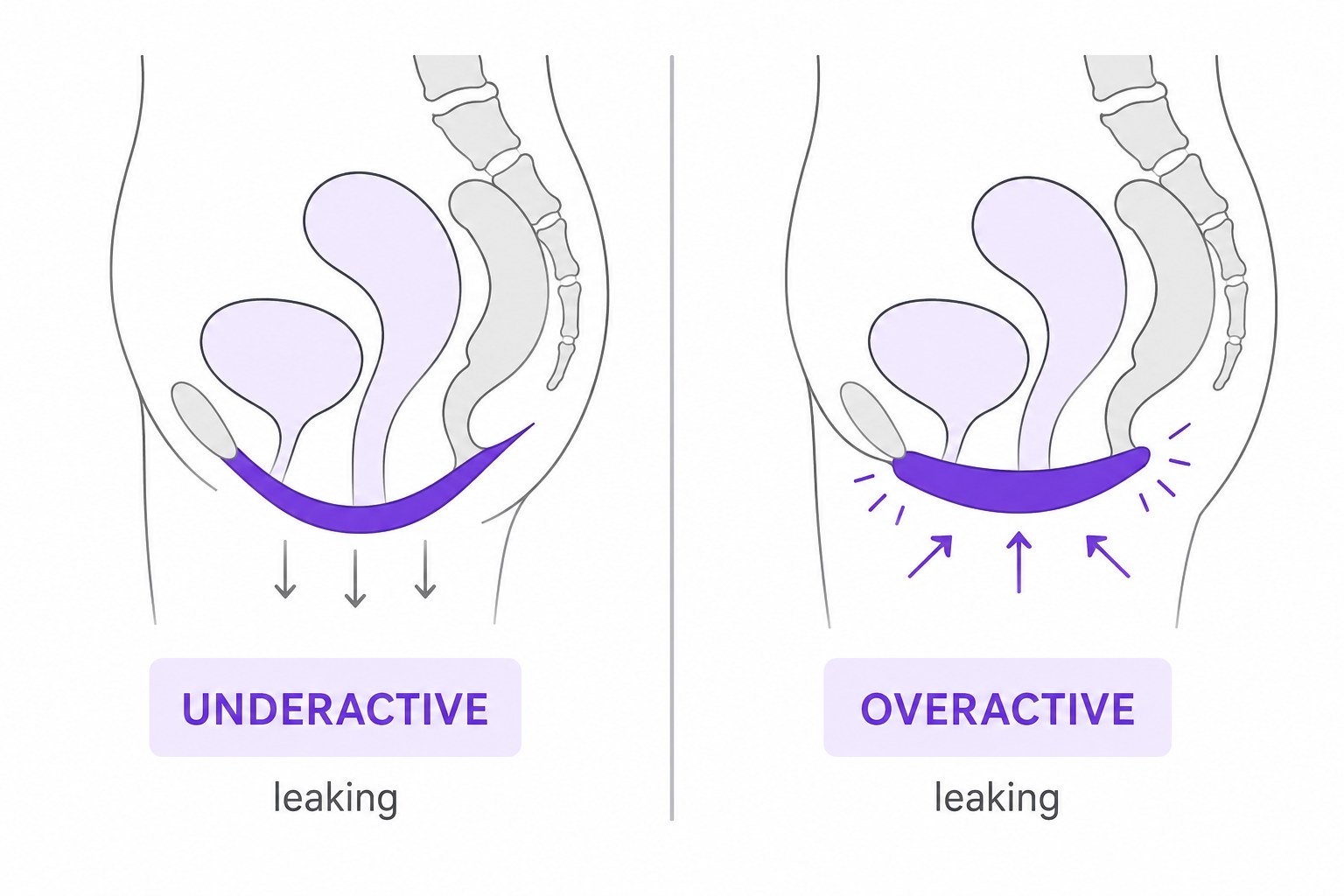
| Weak (underactive) | Tight (hypertonic) | |
|---|---|---|
| Main issue | The floor cannot hold enough | The floor cannot let go enough |
| Typical signs | Leaking with coughs, sneezes or jumping, a heavy feeling late in the day | Urgency, slow stream, constipation, pain with sex, pelvic or tailbone pain |
| How a squeeze feels | Weak or hard to feel | Often strong, but releasing is hard |
| Effect of more Kegels | Often helpful when done correctly | Can add tension, discomfort or urgency |
| Usual starting point | Strength training, done correctly | Learning to release first, then strength if needed |
Here is the catch: both types can cause leaking and urgency, so from the inside they can feel similar. That is why so many women train hard and see no change. The full comparison is in the complete pelvic floor guide, and the most common training mistakes are in still leaking after Kegels?
8 signs your pelvic floor may be too tight
None of these signs proves a hypertonic pelvic floor. Each of them can have other causes. Several of them together are a good reason to get assessed.
1. You need to pee often or urgently, even with little in your bladder
A floor that is always on guard can make the bladder feel full sooner. Urgency and frequency are also typical of bladder infections and overactive bladder, which need a doctor.
2. Your stream is slow, hesitant or stops and starts
To pee, the pelvic floor has to relax. When it cannot let go fully, starting can take a while, the stream may be weak, and you may feel you have not fully emptied.
3. Constipation, straining or a feeling you cannot fully empty your bowels
The same logic applies to the bowel. The Mayo Clinic review lists defecation problems among the core symptoms of a non-relaxing pelvic floor (Faubion et al., 2012).
4. Pain with sex, tampons or gynecological exams
Pain with penetration is one of the most common reasons women are referred to a pelvic floor physiotherapist. It can also come from vaginal dryness during menopause, infections, endometriosis and other conditions, so it always deserves a medical assessment.
5. Pelvic, tailbone, hip or lower back pain without a clear cause
Tension in the pelvic floor can refer pain to nearby areas. Pain that does not fit any obvious injury is worth mentioning to your doctor or a pelvic health physiotherapist.
6. You leak even though your squeeze feels strong
This one surprises many women. A muscle that is already half contracted has little range left to respond quickly when you cough or sneeze. Strong does not always mean well coordinated.
7. Kegels made nothing better, or made it worse
If weeks of correct, consistent Kegels brought more discomfort, urgency or pain instead of improvement, a tight floor is one possible explanation. In a well known study, about half of women given clear verbal instructions could not perform a correct pelvic floor contraction, and around a quarter pushed down instead of lifting (Bump et al., 1991). So it is also worth checking your technique.
8. You catch yourself clenching all day
Glutes tight while standing in line, jaw clenched at the laptop, belly pulled in, shoulders up. Many pelvic health physiotherapists report that the pelvic floor often grips along with the rest of the body under stress. This link has not been well studied, but if you recognize a whole-body bracing pattern, it is worth noticing. More on that state in tired but wired.
The breathing check: does your pelvic floor move?
This is a body awareness exercise, not a diagnostic test.
Lie on your back with your knees bent and one hand resting low on your belly. Breathe in slowly through your nose and let your belly and lower ribs widen. Breathe out slowly through your mouth.
Notice what happens at the base of your pelvis. Many people feel a gentle widening and softening as they breathe in, and a slight lift as they breathe out.
Why this matters: in a dynamic MRI study, the diaphragm and the pelvic floor moved in parallel during breathing in healthy women, both moving down on the in-breath and up on the out-breath (Talasz et al., 2011). It was a small pilot study with eight healthy volunteers, so it describes a normal pattern rather than proving anything about pelvic floor problems. Still, if you feel nothing at all, or you notice you are gripping or holding your breath, that is useful information to bring to a professional.
Want guidance? Try the breathing reset.
Why more Kegels may not be the first step
Kegels are a well supported treatment for one problem: stress urinary incontinence caused by a weak pelvic floor. A Cochrane review found supervised pelvic floor muscle training effective for this group (Dumoulin et al., 2018).
A tight floor is a different starting point. Training a muscle that cannot relax with more contractions can make it more tired and more tense. That is why pelvic health physiotherapists commonly start with relaxation, breathing and coordination before adding strength, and why the first question is always which type of floor you have.
There is also a timing detail most programs skip: every contraction should end with a full release that lasts longer than the hold. If you cannot fully let go after a squeeze, that release is the exercise.
What the research says can help
Pelvic floor physical therapy
The Mayo Clinic review names referral to a physical therapist with expertise in pelvic floor disorders as a cornerstone of managing a non-relaxing pelvic floor, together with education about how these muscles work (Faubion et al., 2012).
In a randomized trial in 81 women with bladder pain syndrome and tender pelvic floor muscles, 59 percent responded to ten sessions of specialized pelvic floor myofascial physical therapy, compared with 26 percent who received general massage (FitzGerald et al., 2012). This was a specific patient group treated by trained specialists, so the result cannot be transferred directly to everyone. It does show that hands-on pelvic floor therapy can make a measurable difference for some women.
Breathing and down-training
Slow breathing with a soft belly on the in-breath, and gentle positions that open the hips, are common starting points for learning to relax the pelvic floor. They are low-risk and easy to try at home. Try the guided butterfly release.
Daily habits that quietly add tension
- Going to the bathroom just in case, which teaches the bladder to call early
- Hovering over public toilet seats instead of sitting down fully
- Pushing to speed up peeing instead of letting the flow come
- Straining on the toilet instead of breathing out slowly
- Holding your breath every time you lift something
- Sucking your belly in all day
When to see a professional
See a doctor promptly if you have burning when you pee, blood in your urine or stool, fever, pain that is severe or getting worse, a bulging or dragging feeling in the vagina, bleeding after menopause or between periods, or unexplained weight loss. Seek emergency care immediately if you suddenly cannot pee at all, or if you have new numbness around your genitals or bottom, or new loss of bladder or bowel control. If you are pregnant or recently gave birth, speak to your midwife or doctor before starting any pelvic floor routine.
For pain with sex, ongoing pelvic pain, urgency or constipation that does not improve, ask your doctor about a referral to a pelvic health physiotherapist. In many countries you can book one directly. A specialist can examine the muscles and tell you whether your floor is tight, weak or both, which no checklist can do.
If pain, past painful experiences or anxiety make an examination feel difficult, it is okay to say so. Pelvic health physiotherapists are used to going slowly and explaining every step.
The bigger picture: the floor is part of a system
The pelvic floor is the bottom of a pressure system. The diaphragm sits at the top, the deep belly muscles at the front, and the pelvis is the base. When one part stays braced, the others often follow. That is why posture and breathing come up so often in pelvic floor work, and why a forward-tilted pelvis can change how much load reaches the floor. More on that in the anterior pelvic tilt guide and in bloated by evening, or is it your pelvis?
Strength first or release first?
Knowing that your pelvic floor might be too tight is the first step. The harder part is what comes next: finding out whether you need to release first, strengthen first, or both in the right order, then practising it consistently and seeing whether it works. That decision is exactly what most programs skip, and it is why so many women give up after weeks of the wrong exercise.
Fix Your Pelvic Floor Workbook for Women
An 8-week plan to understand your pelvic floor, train it in the right order and track what changes, at home.
$16.99, instant download
- 4 self-tests and the Release Gate: a decision step that helps you choose between strength first and release first
- Release and breathing work for a floor that struggles to let go
- 3 illustrated levels for every exercise: Beginner, Standard, Pro
- Video demos for the key exercises via QR code and clickable links
- The Knack, bladder and bowel logs and 5 daily micro habits
- Printable 8-week tracker in US Letter and A4
- Bonus included: exercise poster with all 15 movements
Please note: the workbook is educational self-help. It does not diagnose or treat any medical condition and does not replace an examination by a doctor or pelvic health physiotherapist.
Get the workbook: instant PDF downloadPrefer the paperback? Get it on Amazon
Educational self-help, not medical treatment. Results vary from person to person.
Frequently asked questions
What is a hypertonic pelvic floor?
A hypertonic pelvic floor is a pelvic floor whose muscles stay tense and have difficulty relaxing fully. It is also called an overactive or non-relaxing pelvic floor. It can be linked to urinary and bowel symptoms, pain with sex and pelvic pain, and it is diagnosed through an examination by a doctor or pelvic health physiotherapist.
What are the signs of a tight pelvic floor?
Possible signs include urgency and frequent peeing, a slow or hesitant stream, constipation and straining, pain with sex or tampons, pelvic, tailbone or hip pain, leaking despite a strong squeeze, and Kegels that make symptoms worse. These signs can also have other causes, such as infections or endometriosis, so they need a professional assessment.
Can Kegels make a tight pelvic floor worse?
They can. If the pelvic floor already struggles to relax, adding more contractions can increase tension, discomfort or urgency for some women. That is why pelvic health physiotherapists often start with relaxation and breathing work before strengthening when the floor is tight.
How do I know if my pelvic floor is too tight or too weak?
Leaking with coughs or sneezes and a weak feeling when you squeeze point more toward weakness. Urgency, pain, constipation and no progress with Kegels point more toward tightness. Many women have features of both. Only an examination by a pelvic health physiotherapist can tell reliably.
Can stress cause a tight pelvic floor?
Many pelvic health physiotherapists report that the pelvic floor often tightens along with the rest of the body under stress, for example together with the jaw, shoulders and glutes. This link has not been well studied, and a tight pelvic floor usually has several contributing factors.
How do you relax a tight pelvic floor?
Common starting points are slow breathing with a soft belly on the in-breath, gentle hip-opening positions, and avoiding habits like straining or hovering over the toilet. Specialized pelvic floor physical therapy has shown benefit in research for some groups of women. If symptoms persist, see a pelvic health physiotherapist.
Does pelvic floor physical therapy help?
For a non-relaxing pelvic floor, pelvic floor physical therapy is described as a cornerstone of management in a Mayo Clinic review. In one randomized trial in women with bladder pain syndrome and pelvic floor tenderness, 59 percent responded to specialized pelvic floor therapy compared with 26 percent who received general massage.
When should I see a doctor about pelvic floor symptoms?
See a doctor if you have burning when you pee, blood in your urine or stool, fever, severe or worsening pain, a bulging feeling, or bleeding after menopause. Seek emergency care if you suddenly cannot pee, or have new numbness around the genitals or new loss of bladder or bowel control.
Sources
- Faubion SS, Shuster LT, Bharucha AE. Recognition and management of nonrelaxing pelvic floor dysfunction. Mayo Clinic Proceedings. 2012;87(2):187-193.
- Talasz H, Kremser C, Kofler M, Kalchschmid E, Lechleitner M, Rudisch A. Phase-locked parallel movement of diaphragm and pelvic floor during breathing and coughing: a dynamic MRI investigation in healthy females. International Urogynecology Journal. 2011;22(1):61-68.
- FitzGerald MP, Payne CK, Lukacz ES, et al. Randomized multicenter clinical trial of myofascial physical therapy in women with interstitial cystitis/painful bladder syndrome and pelvic floor tenderness. Journal of Urology. 2012;187(6):2113-2118.
- Bump RC, Hurt WG, Fantl JA, Wyman JF. Assessment of Kegel pelvic muscle exercise performance after brief verbal instruction. American Journal of Obstetrics and Gynecology. 1991;165(2):322-327.
- Dumoulin C, Cacciari LP, Hay-Smith EJC. Pelvic floor muscle training versus no treatment, or inactive control treatments, for urinary incontinence in women. Cochrane Database of Systematic Reviews. 2018.
This article is for educational purposes only and is not medical advice, diagnosis or treatment. Tom Brecker is a sports scientist, not a physician or physiotherapist. Pelvic floor symptoms can have many causes, some of them serious. If your symptoms are persistent, painful, new or getting worse, see a doctor or a pelvic health physiotherapist.
Part of the Pelvic Floor guide. Read the complete guide to the pelvic floor