
Tension headache prevention: why tiny daily habits often outlast big lifestyle changes
25 October 2026 · 9 min read · Tom Brecker, BSc Sports Science
Educational information, not medical advice.
Maybe you know the plan. Yoga three times a week. No screens after 9 p.m. Eight glasses of water. A real lunch break, away from the desk.
And maybe you also know how it usually ends: by the second week of February, the painkillers are back in the bag.
The plan is not wrong. Every item on it is sensible. It just rarely touches the place where tension headaches are often built: the hundreds of small moments between 8 a.m. and 4 p.m. when the shoulders creep up and nobody notices.
That is the question most tension headache advice skips. Not which habits. What size.
Macro habits vs micro habits: what is the difference?
A macro habit is a big, scheduled block: a class, a workout, a 30-minute meditation, a full evening routine. It needs time, planning and motivation.
A micro habit takes under 30 seconds, needs no extra time and is attached to something you already do dozens of times a day. Opening a door. Unlocking your phone. Stopping at a red light.
Both are useful. They just solve different problems.
| Macro habit | Micro habit | |
|---|---|---|
| Example | Yoga class, 30-minute meditation, gym session | Shoulder drop at every doorway, one long exhale at every red light |
| Time needed | 20 to 60 minutes, scheduled | Under 30 seconds, no schedule |
| How often | A few times a week | Many times a day |
| When it happens | Usually when you are already calm | In the middle of your normal day, when the tension builds |
| What it needs | Motivation and free time | A cue you already have |
| A bad week | Often dropped completely | Usually survives, because it is too small to skip |
Why big habit changes so often fail for tension headaches
1. They work on the wrong clock
I picture tension as a ledger. Every tense email, every hour hunched at the laptop, every clenched jaw in traffic is a small deposit. None of them hurts on its own. By 4 p.m. the balance is high enough that you feel it as a band around your head.
A yoga class on Wednesday evening pays off part of that balance. But on Monday, Tuesday and Wednesday the deposits kept coming, all day, in small amounts. A once-a-week payment cannot keep up with a many-times-a-day deposit. That is not a scientific model, just the picture that finally made sense of my own afternoons.
2. They run on motivation, and motivation runs out around week three
Big plans start strong. The first week feels great. Then work gets busy, a child gets sick, the class gets moved, and by week three the routine quietly disappears. I see the same pattern with posture work, and I wrote about it in how long it really takes to fix anterior pelvic tilt. Headaches follow the same timeline.
3. They are all or nothing
Miss Wednesday's class and the whole week feels lost. That feeling is the real habit killer. Research on habit formation is reassuring here: missing a single opportunity did not materially affect how a habit formed, while people who were very inconsistent did not build the habit at all (Lally et al., 2010). A micro habit with twenty chances a day makes "very inconsistent" much harder to reach.
4. They happen when you are already calm
A relaxation session in a quiet room trains you to relax in a quiet room. The bracing that loads your neck happens somewhere else: in the meeting, at the laptop, on the phone with the insurance company. If you have read why your tension headaches keep coming back, you know the Evasive Pattern. It shows up dozens of times a day, so that is how often the counter-habit needs to show up too.
What the research says about small, frequent habits
Simple habits become automatic faster
In a well-known study from University College London, 96 volunteers each picked one new daily behaviour and tracked how automatic it felt over 12 weeks (Lally et al., 2010). On average it took 66 days for a behaviour to feel automatic, with a huge range from 18 to 254 days. Simpler behaviours, like drinking a glass of water with a meal, tended to become automatic faster than more demanding ones, like exercise.
Habit researchers also recommend tying a new behaviour to a consistent cue in your day, so it gets triggered by the situation rather than by willpower (Gardner et al., 2012). That is the core of every micro habit.
Short, regular exercises reduced headache days at work
The most useful trial for this question comes from Italy. Researchers randomized whole departments of public servants: 923 workers received a programme of education plus short neck and shoulder posture and relaxation exercises meant to be practised regularly during the day, and 990 workers in other departments received nothing (Mongini et al., 2012).
The programme group was more likely to cut their headache frequency in half, and on average had about 1.7 fewer headache days per month than the control group. Neck and shoulder pain improved too.
Honest limits: it was a workplace study, it included different headache types and not only tension-type headache, and participants knew which group they were in. It does not prove that micro habits alone fix tension headaches. It does suggest that small, repeated practice spread through a normal working day can make a measurable difference.
Three micro habits to try this week
The formula is simple: After I [something I already do], I [one tiny action].
1. The doorway shoulder drop
Every time you walk through a door, let your shoulders drop away from your ears. One second. No one will notice. Watch the Shoulder Drop video once so you know what a real drop feels like.
2. The red light exhale
Every red light, or every time you unlock your phone, breathe out for longer than you breathed in. One breath. If you want to feel the difference first, try The Long Exhale.
3. The sip check
Every time you take a sip of water or coffee, check your jaw: lips together, teeth apart, tongue resting. Many people discover they were clenching without knowing it.
Here is the catch. Start all three on Monday and by Thursday you will remember none of them. That is the macro mistake again, just cut into smaller pieces. In my own experience, the order and the pace mattered more than the habits themselves: which one comes first, when to add the next, and what to do on the week everything falls apart. That is the part I built the workbook around.
Where the big habits still matter
Micro habits are not a replacement for the basics. Some of the most commonly recommended steps for tension headaches are macro by nature:
- Regular sleep and wake times, because poor sleep can lower your pain threshold
- Regular meals and enough fluids
- Regular movement, including some strength work for the upper back (try the upper back reset)
- Breaks from long screen sessions
- Keeping count of painkillers: taking simple painkillers on 15 or more days a month for over three months can itself drive more headaches (ICHD-3). Talk to your doctor before changing any medication.
Think of it this way: the macro habits set the floor. The micro habits can influence how much tension piles up on top of it every day. If stress is your biggest driver, the Stress & Cortisol guide and the article on high cortisol symptoms in women are good next reads.
Quick check: are you stuck in the macro trap?
Answer yes or no:
- Does your headache plan only start once the pain is already there?
- Is your main relaxation tool something that needs 20 minutes or more?
- Have you restarted the same routine more than twice this year?
- Do you only notice your shoulders when they already hurt?
- Does one missed day make the whole week feel lost?
Three or more yes answers? It may not be a willpower problem. Your habits may simply be the wrong size for the problem. This check is for self-reflection only and is not a diagnosis. A good first measure is how early you notice tension building, which I call catch-time. I explain it in why your tension headaches keep coming back.
Why knowing this is still not enough
Choosing a micro habit is easy. The hard part is everything after: stacking them in an order your day can actually carry, seeing proof that they work before your headache count moves, and having a plan for the week when everything goes wrong and the headaches come back.
Without that structure, most people slide back into the January plan. That is exactly why I built a 30-day system around it.
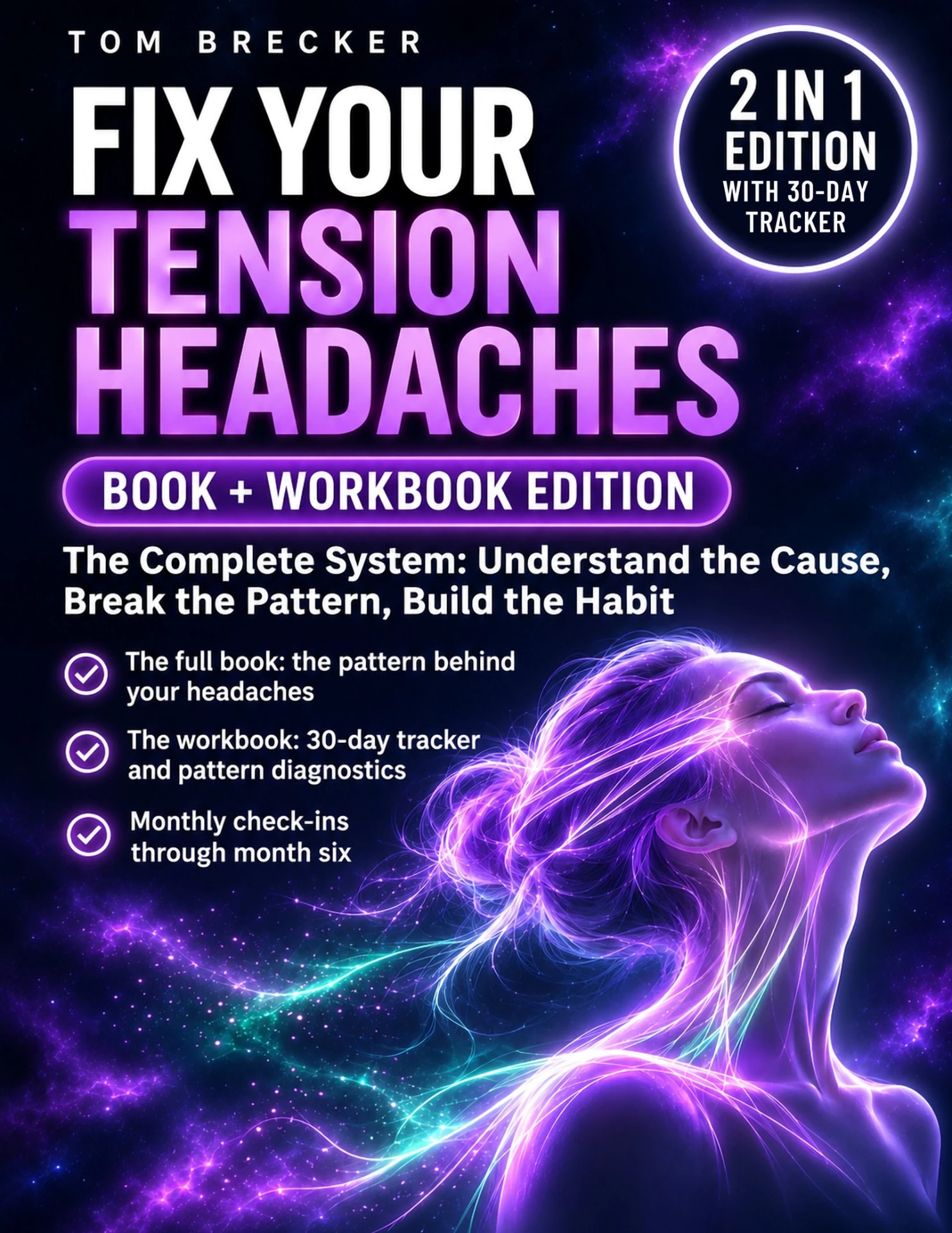
Fix Your Tension Headaches: Book + Workbook Edition
The full story behind this article, plus the practical system to run it:
- The book: the Evasive Pattern, the painkiller trap, trigger point work at home with clear safety notes, the sleep transition, and the three kinds of setbacks almost everyone hits
- The workbook: your Headache Profile with four starting numbers, a trigger inventory, your personal pattern map, a bad-week reset and a 30-day tracker that adds one layer at a time
- A separate printable tracker in US Letter and A4, so you only print what you need, or fill it in on your tablet
Get the Book + Workbook ($19.99)Prefer the paperback? Get it on Amazon
Instant PDF download. Start with the 5-Minute Relief Reset tonight.
Educational self-help, not medical treatment. Results vary from person to person.
When a headache is not a tension headache
Please see a doctor promptly, and seek emergency care for the first two, if your headache:
- Comes on suddenly and severely, like a thunderclap or "the worst headache of my life"
- Comes with fever, stiff neck, confusion, weakness, numbness, slurred speech or vision loss
- Starts after a head injury
- Is new after age 50, or has clearly changed in pattern or severity
- Wakes you from sleep, or gets worse when you cough, strain or lie down
- Comes with nausea, vomiting or strong light sensitivity (this may be migraine, which needs a different approach)
Everything in this article assumes your doctor has ruled out other causes.
The bigger picture
Small, repeated habits are the same idea behind everything on this site. The same logic explains why some people take hours to come back down after stress (how long does it take you to calm down?) and why you can feel exhausted and wired at once (tired but wired). For everything about tension headaches in one place, read the complete Tension Headaches guide. For guided practice, try the neck and shoulder reset and the breathing reset.
FAQ
What daily habits help prevent tension headaches?
Commonly recommended habits include regular sleep and wake times, regular meals and fluids, regular movement, screen breaks and managing stress. Many people also benefit from tiny habits spread across the day, such as dropping the shoulders, relaxing the jaw and taking one long exhale, attached to things they already do.
What is the difference between micro habits and macro habits?
A macro habit is a big, scheduled block of time, such as a class or a workout. A micro habit takes under 30 seconds, needs no extra time and is attached to an existing cue, such as walking through a door or stopping at a red light.
How long does it take for a new habit to help with tension headaches?
It varies a lot. In one study, simple daily behaviours took 66 days on average to feel automatic, with a range from 18 to 254 days. Many people notice they catch tension earlier before they notice fewer headaches.
Are big lifestyle changes useless for tension headaches?
No. Sleep, regular meals, movement and screen breaks set the foundation. The problem is that big changes are hard to keep, and they do not act during the moments when tension builds. Combining a stable foundation with small daily habits is usually more realistic.
How many micro habits should I start with?
One. Add the next only once the first runs without reminders. Starting several at once tends to repeat the same overload that makes big plans fail.
Can short exercises at work reduce tension headaches?
A large workplace trial found that education plus short neck and shoulder posture and relaxation exercises, practised regularly during the day, reduced headache days compared with no programme. It included different headache types, so results may vary.
Why do I keep quitting my headache routine?
Most routines are too big for a normal week. They need free time and motivation, and one missed session feels like failure. Habits that are tiny and attached to existing cues tend to be easier to keep, and in one well-known study, missing a single day did not undo the habit-forming process.
When should I see a doctor about tension headaches?
See a doctor if headaches are frequent, getting worse or affecting your daily life, and seek urgent care for a sudden severe headache or one with fever, stiff neck, confusion, weakness, numbness or vision changes.
Sources
- Lally P, van Jaarsveld CHM, Potts HWW, Wardle J. How are habits formed: modelling habit formation in the real world. European Journal of Social Psychology. 2010;40(6):998-1009.
- Gardner B, Lally P, Wardle J. Making health habitual: the psychology of "habit-formation" and general practice. British Journal of General Practice. 2012;62(605):664-666.
- Mongini F, Evangelista A, Milani C, et al. An educational and physical program to reduce headache, neck/shoulder pain in a working community: a cluster-randomized controlled trial. PLoS One. 2012;7(1):e29637.
- Headache Classification Committee of the International Headache Society. The International Classification of Headache Disorders, 3rd edition (ICHD-3). Cephalalgia. 2018;38(1):1-211.
This article is for educational purposes only and is not medical advice, diagnosis or treatment. Tom Brecker is a sports scientist, not a physician. If you have frequent, new or worsening headaches, please see a doctor.
Part of the Tension Headaches guide. Read the complete guide to tension headaches