
Cortisol belly fat: what the studies actually show (and what Instagram leaves out)
10 October 2026 · 9 min read · Tom Brecker, BSc Sports Science
You cut the wine. You walk every day. You eat more vegetables than you have in years. And the lower belly does not move.
At some point a video tells you why: cortisol. Stress hormone, belly fat, case closed. Buy this supplement, drink this mocktail, stop doing cardio.
Here is the uncomfortable part. Cortisol really can push fat toward your middle. The research on that is solid. But the version you have been sold skips three things: how small the effect is for most people, what else is happening to women's bodies after 40, and the one stress lever that moves fat faster than anything you can buy.
This article goes through the studies one by one. Where the evidence is strong, I say so. Where it is weak, I say that too. If you want the bigger picture on how stress and cortisol work, the complete stress and cortisol guide covers it.
The short answer Cortisol can shift fat storage toward the abdomen. That is clearest in Cushing's syndrome, where cortisol is pathologically high. In everyday chronic stress the link is real but modest, it runs in both directions, and it is rarely the only driver. For women over 45, falling oestrogen, short sleep, alcohol and muscle loss usually matter as much or more. What works is lowering the load on your stress system and protecting sleep. Supplements and "cortisol cocktails" have little or no evidence behind them.
What cortisol actually does to belly fat
Cortisol is not a villain. It gets you out of bed, raises blood sugar when you need fuel and keeps inflammation in check. Problems start when it stays high, or never comes back down after it rises.
Three mechanisms connect it to your waistline:
1. Your deep belly fat listens to cortisol more closely. Visceral fat, the fat packed around your organs behind the abdominal wall, carries more glucocorticoid receptors than fat on your hips or thighs. When cortisol is high, that tissue responds first.
2. Your belly fat makes its own cortisol. This is the part almost nobody mentions. Fat tissue contains an enzyme called 11β-HSD1 that turns inactive cortisone back into active cortisol, right there in the tissue. A 1997 paper in The Lancet found this enzyme especially active in omental (deep belly) fat and asked whether central obesity might be "Cushing's disease of the omentum". Translation: your blood cortisol can look normal while the fat around your middle runs its own local supply.
3. Cortisol plus insulin is a storage signal. Cortisol raises blood sugar. Your body answers with insulin. High cortisol and high insulin together favour fat storage in the abdomen, and stress also nudges you toward food that is fast, sweet and fatty.
That is the mechanism. Now the question that matters: how much does it explain in real people?
The study everyone quotes, and what it actually found
Almost every "cortisol belly" post traces back to one paper. In 2000, Elissa Epel and colleagues at Yale brought 59 premenopausal women into the lab on three consecutive days and gave them stressful tasks: public speaking, mental arithmetic, puzzles under time pressure.
The finding was striking. Women who stored fat around the waist released more cortisol in response to stress, and they kept doing so on day three, when others had adapted. The detail that made headlines: this held for slender women with abdominal fat too. You did not have to be overweight to show the pattern.
What it did not show:
- It does not prove cortisol caused the belly fat. The women were measured once, not followed over time.
- 59 women in a lab is a starting point, not a verdict.
- It measured reactions to lab stress, not daily life.
It is a good study. It is not the closing argument it is often made out to be.
The studies that complicate the story
The big one: 2,527 people, hair samples. Cortisol in hair reflects roughly the last two months, which makes it a far better measure of chronic stress than a single saliva test. In 2017, researchers at University College London analysed hair cortisol in 2,527 adults aged 54 and older from the English Longitudinal Study of Ageing. Higher hair cortisol went with larger waists, higher weight and higher BMI, and people who stayed obese over four years had the highest levels.
Strong evidence that chronic stress and belly fat travel together. But the authors themselves point out the problem: the data cannot show which came first. Excess visceral fat raises cortisol too, partly through that enzyme in the fat tissue. It is a loop, not a straight line.
The review that says "inconclusive". A 2015 systematic review in Psychoneuroendocrinology (Incollingo Rodriguez, Epel and colleagues) looked at cortisol in obesity across measures: morning rise, daily curve, reactivity, total output. Their verdict on circulating cortisol: "The literature to date is inconclusive." What they did find consistent was cortisol activity inside fat tissue itself.
The effect size problem. Large reviews of stress and weight gain over time find a link, but a small one on average. Some people gain under stress, some lose, many stay the same. Stress raises the odds. It does not doom everyone equally.
Verdict so far: cortisol is a real contributor to belly fat, mostly through local activity in visceral fat and through behaviour (eating, sleeping, moving less). It is not a switch that explains everything, and a "high cortisol" label from a video is not a diagnosis.
The part nobody tells women over 45
If you are in your mid-forties or older and your waist changed without your habits changing, cortisol is probably not the main character. Oestrogen is.
A four-year study published in the International Journal of Obesity (Lovejoy et al., 2008) followed 156 women through the menopausal transition with yearly scans. All of them gained some fat under the skin of the abdomen. Only the women who became postmenopausal showed a significant increase in visceral fat. In the subgroup measured in a metabolic chamber, their fat burning dropped by 32 percent, and their energy use during sleep fell about one and a half times faster than in women who stayed premenopausal.
Now stack stress on top. In a 2015 study in Biological Psychiatry, Janice Kiecolt-Glaser's team gave 58 women (average age 53) a high-fat meal and measured their metabolism for seven hours. Women who had a stressful day before burned 104 fewer calories after the same meal, had higher insulin and burned less fat. The researchers estimated this could add up to almost 5 kg (11 lb) a year, though that figure is an extrapolation, not a measured result.
That is the real picture for many women: lower oestrogen moves fat to the middle, and stress makes the body hold on to it more efficiently. Neither is a character flaw. Both are biology.
Sleep: the cortisol lever that actually moves fat
If you only change one thing after reading this, make it sleep.
Short sleep raises evening cortisol. A classic 1999 study in The Lancet (Spiegel, Leproult and Van Cauter) restricted healthy young men to four hours a night for six nights and found higher evening cortisol and worse glucose tolerance.
The fat-loss data is even harder to ignore. In a 2010 trial in the Annals of Internal Medicine, overweight adults dieted for two weeks twice: once sleeping 8.5 hours, once sleeping 5.5 hours. Same diet, same calories. With short sleep, the share of weight lost as fat dropped by 55 percent and loss of lean mass rose by 60 percent. They were also hungrier.
Read that again. Same diet, half the fat loss, just from sleep. The study was small (10 people, two weeks), but it is one of the clearest experiments we have, and it matches everything else known about sleep and appetite hormones.
If you wake at 3 a.m. and lie there with your heart going, that is not a sleep problem in isolation. It is a stress system that will not stand down. I wrote about that state in tired but wired.
Claim check: what holds up and what does not
| Claim you have seen online | What the evidence says | Verdict |
|---|---|---|
| "Stress causes belly fat" | Linked in large studies, partly through local cortisol in visceral fat. Runs both ways. Modest average effect. | Partly true |
| "Your saliva test shows high cortisol, that is why" | Cortisol changes hour to hour. A single home saliva test says very little about chronic levels. | Weak |
| "Cortisol cocktail" (orange juice, coconut water, salt) | No published trials on cortisol or fat. Hydration and a calm morning are fine, the claims are not. | No evidence |
| "Ashwagandha lowers cortisol belly" | Small trials show lower measured cortisol and stress scores. Effects on belly fat are minimal and studies are short and often industry funded. Rare liver injury has been reported. | Weak for fat |
| "Stop cardio and HIIT, they raise cortisol" | Exercise raises cortisol briefly, then it falls. Meta-analyses show aerobic exercise reduces visceral fat, even with little weight loss. | False |
| "Cut all carbs to lower cortisol" | Very low carb diets can raise cortisol in some people. Belly fat loss tracks total energy, protein and sleep, not carb elimination. | Misleading |
| "Menopause belly is just cortisol" | Falling oestrogen independently shifts fat to the abdomen. | Incomplete |
Before you blame cortisol: is it even fat?
Here is a curiosity worth checking before you change anything else. A lot of women who are convinced they have "cortisol belly" have a lower belly that pushes forward because of how the pelvis sits, not because of how much fat is there.
Long hours of sitting tilt the pelvis forward. The lower belly pops, the lower back arches, and no amount of stress work changes it, because it is a position problem. The tell: your belly looks flatter lying down and pushes out the moment you stand.
If that sounds familiar, read why your lower belly sticks out even when you are not gaining weight and skinny fat or anterior pelvic tilt first. Many women have both, and it helps to know which one you are fighting.
What actually lowers the load, in rough order
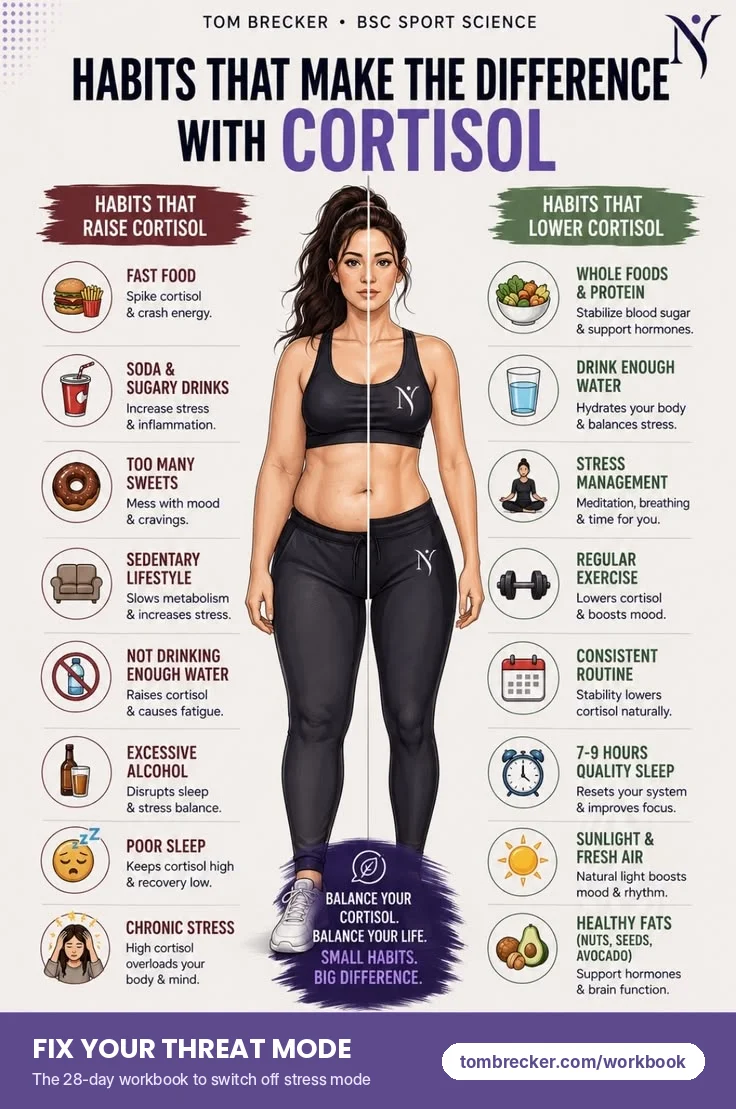
Save the cheat sheet. Below is the order I would actually do it in, based on how strong the evidence is.
- Protect 7 to 9 hours of sleep. Strongest evidence for both cortisol and fat loss. Same bedtime, dark cool room, no news in bed.
- Cut alcohol hard, especially in the evening. It fragments sleep, raises next-day cortisol and adds calories that land on the belly first.
- Walk daily and lift twice a week. Aerobic exercise reduces visceral fat. Strength training protects the muscle that midlife and dieting both strip away.
- Eat enough protein and fibre. It steadies blood sugar and appetite. You do not need to cut carbs, you need to stop running on empty and then crashing.
- Shorten your recovery window. This is the step most people skip, and the one that matters most for chronic stress. Not "relax more", and not another vagus nerve hack, but training your body to come back down after something stresses it. Start with the long exhale and the full body shake.
- Skip the shortcuts. No cortisol cocktail, no mystery supplement, no 5 a.m. ice bath if you are already running on fumes.
The number that matters more than your cortisol level
Here is the shift that changed how I think about all of this.
Your cortisol going up is not the problem. It is supposed to go up. The problem is how long it takes to come back down. A body that spikes at 10 a.m. and settles by 10:30 is healthy. A body that spikes at 10 a.m. and is still on alert at midnight is the one that stores fat around the middle, wakes at 3 a.m. and feels tired and wired at once.
That gap has a name: your recovery window. You can measure it, and you can shorten it. Most people never check it. I explain how to measure yours in how long does it take you to calm down?
If you want the full system Fix Your Threat Mode is the practical workbook: a 28-day protocol, 60 exercises, 6 guided video exercises, the Recovery Window assessment, situation cards for 3 a.m. waking and rising panic, and tracking pages with a twelve-week plot so you can see your recovery window shrink on paper. Every exercise carries an honest evidence rating. Digital download, currently $19.90 instead of $49.90. See what is inside.
Prefer to understand it first? Fix Your Chronic Stress explains why your body got stuck in stress mode and why it is not a willpower problem.
Frequently asked questions
Does cortisol cause belly fat?
It can contribute. Cortisol favours fat storage in visceral (deep belly) fat, and belly fat produces cortisol locally through the enzyme 11β-HSD1. In everyday chronic stress the effect is real but modest and works in both directions. Very high cortisol, as in Cushing's syndrome, clearly causes central fat gain.
How do I know if my belly fat is from cortisol?
You cannot tell from looking, and a single saliva test is not reliable. Signs that stress plays a big role: poor sleep, waking at 3 or 4 a.m., feeling tired and wired, stress eating, and a waist that grew during a stressful period. A doctor can test for cortisol disorders if you have other symptoms such as easy bruising, muscle weakness or high blood pressure.
Is menopause belly the same as cortisol belly?
No. Falling oestrogen during the menopausal transition independently shifts fat to the abdomen and lowers fat burning. Stress and poor sleep can add to it, which is why many women over 45 feel their body changed overnight.
How long does it take to lose stress belly fat?
Visceral fat responds faster than fat under the skin. With better sleep, less alcohol, daily walking and strength training, measurable changes in waist circumference usually show within 8 to 12 weeks.
Does ashwagandha reduce cortisol belly fat?
Small trials show it can lower measured cortisol and stress scores. There is no good evidence that it reduces belly fat in a meaningful way, and rare cases of liver injury have been reported. Talk to your doctor before taking it, especially if you take other medication.
Should I stop HIIT if I have high cortisol?
No. Exercise raises cortisol briefly and then it falls. Regular aerobic exercise reduces visceral fat. If you are exhausted, swap some intense sessions for walking and strength work rather than stopping.
Sources
- Epel ES, McEwen B, Seeman T, et al. Stress and body shape: stress-induced cortisol secretion is consistently greater among women with central fat. Psychosomatic Medicine. 2000;62(5):623-632.
- Bujalska IJ, Kumar S, Stewart PM. Does central obesity reflect "Cushing's disease of the omentum"? The Lancet. 1997;349(9060):1210-1213.
- Jackson SE, Kirschbaum C, Steptoe A. Hair cortisol and adiposity in a population-based sample of 2,527 men and women aged 54 to 87 years. Obesity. 2017;25(3):539-544.
- Incollingo Rodriguez AC, Epel ES, White ML, et al. Hypothalamic-pituitary-adrenal axis dysregulation and cortisol activity in obesity: a systematic review. Psychoneuroendocrinology. 2015;62:301-318.
- Lovejoy JC, Champagne CM, de Jonge L, Xie H, Smith SR. Increased visceral fat and decreased energy expenditure during the menopausal transition. International Journal of Obesity. 2008;32(6):949-958.
- Kiecolt-Glaser JK, Habash DL, Fagundes CP, et al. Daily stressors, past depression, and metabolic responses to high-fat meals: a novel path to obesity. Biological Psychiatry. 2015;77(7):653-660.
- Spiegel K, Leproult R, Van Cauter E. Impact of sleep debt on metabolic and endocrine function. The Lancet. 1999;354(9188):1435-1439.
- Nedeltcheva AV, Kilkus JM, Imperial J, Schoeller DA, Penev PD. Insufficient sleep undermines dietary efforts to reduce adiposity. Annals of Internal Medicine. 2010;153(7):435-441.
- Vissers D, Hens W, Taeymans J, et al. The effect of exercise on visceral adipose tissue in overweight adults: a systematic review and meta-analysis. PLoS One. 2013;8(2):e56415.
This article is for education, not medical advice. If your waist changed quickly, or you have symptoms such as easy bruising, muscle weakness or high blood pressure, see a doctor.
Part of the Stress & Cortisol guide. Read the complete guide to stress and cortisol
Free · Seven days · Five minutes a day
Start with day one
Twelve questions, one number, and the Recovery Window. A starting point you can measure against in four weeks.